The House of Mirth: Music for the Play

I’ve been preparing the dramatized version of The House of Mirth for the Oxford University Press edition and have presented on portions of the research a few times: at the Edith Wharton Birthday Talk for the Transatlantic Women Writers series , at the Society for the Study of American Women Writers conference November 6-9, 2025, in Philadelphia, and in June 2026 at the Edith Wharton Summit. So far, I’ve accumulated reviews (107 and counting), reconstructed the tour schedule, and begun collation of the versions. I’m writing an article about this as well as gathering information for the Introduction to the House of Mirth volume.

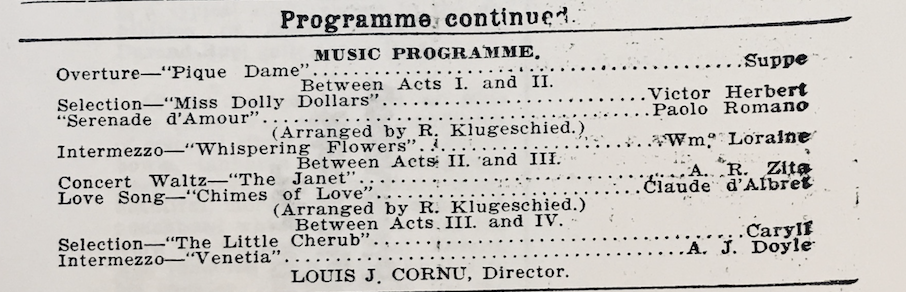
Today I (re)discovered a file with the playbill of The House of MIrth’s dramatized version, which opened in New York at the Savoy Theater on October 22, 1906. Here’s a snippet from the program with links to the music, added here primarily so I won’t lose them before incorporating them into the ongoing work.

  1. Overture from “Pique Dame” by Suppé https://www.youtube.com/watch?v=avhmNBwA6vI

2. “Miss Dolly Dollars” (pretty appropriate for House of Mirth, wouldn’t you say?)

and “lanciers”

3. “Serenade d’Amour” by Paolo Romano https://www.youtube.com/watch?v=5KbgOnSK8wc

4. Intermezzo- Whispering Flowers by William Loraine

5. Concert Waltz-“The Janet” by A. R. Zita. This was apparently part of a series of “concert waltzes,” but I could not find a musical version. https://s9.imslp.org/files/imglnks/usimg/1/19/IMSLP783367-PMLP1239400-Cadenza-08-06.pdf

6. Love Song “Chimes of Love” Claude d’Albret. The score is from 1906, so very up-to-date for the production. https://imslp.org/wiki/Chimes_of_Love_(Albret%2C_Claude_d’). Here’s a catalogue entry for the arrangement in the production: https://m-mulibiiiapps.marshall.edu/search~S12?/eKAO+1225/ekao+++++1225/-3%2C-1%2C0%2CE/frameset&FF=ekao+++++1227&1%2C1%2C

7. “The Little Cherub” by Ivan Caryll. https://imslp.org/wiki/The_Little_Cherub_(Caryll%2C_Ivan) and https://imslp.org/wiki/The_Little_Cherub_(Caryll%2C_Ivan). Also 1906. https://www.youtube.com/watch?v=wN3MHZfpy1k. It’s irrelevant, but I like this one the best.

8. Intermezzo “Venetia” A. J. Doyle. I see this listed here: https://www.mechanicalmusicpress.com/registry/pdf_data/rpt_roll/All_Catalogued_Wurlitzer_Composers.pdf but could not find a version. I’m not a musician, so if there’s information I’m missing, please let me know in the comments.

Sinclair Lewis’s Cass Timberlane and Betty Friedan’s “the problem that has no name”

Sinclair Lewis’s Cass Timberlane: A Novel of Husbands and Wives (1945) isn’t much discussed these days. For obvious reasons, It Can’t Happen Here seems much more germane to the present moment, and it’s not one of the “big 5” of the 1920s: Main Street, Babbitt, Elmer Gantry, Arrowsmith, Dodsworth.

But it’s a worthwhile novel and innovative in ways that Lewis’s novels often aren’t. Lewis experimented with modernist stream-of-consciousness in the party scene in Ann Vickers, but largely his talent was best expressed in his acute eye for the society he was living in and for his satiric take on it. I’m not exactly going out on a limb in saying that, of course–it’s what he’s known for–but he steps away from that a bit in Cass Timberlane and tries something new, the “assemblage of husbands and wives” little vignettes of the characters’ marriages. Lewis was known taking on Big Subjects–small towns, evangelism, medicine, etc.–and this is his Marriage novel.

[Spoilers ahead if you haven’t read it.]

Cass Timberlane is a 40-something judge in Grand Republic, Minnesota; he’s divorced and has a comfortable, if predictable, life before he meets Virginia (Jinny) Marshland, a 20-something young woman who has moved to Grand Republic from her small town of Pioneer Falls and makes a living as a cartoonist for the newspaper. Instead of falling in love with the nice, age-appropriate woman who loves him (Chris Grau), he falls in love with Jinny, of course, and the course of the novel is Cass’s attempt to bridge the gaps between them: their ages, of course, which honestly wouldn’t have been the scandal in 1945 that it is today; their social class (respectable small town middle class versus the town’s elite); and their basic character differences of restlessness (Jinny) and contentment yearning to be restless (Cass). Curiously Jinny seems to have acquired the same Yale education that all of Lewis’s heroes do; she’s remarkably well-read and well-versed in history, mythology, and science and is altogether remarkable.

The short version: Cass courts her at her boarding house, and she meets his disapproving friends; they get married and go to Florida for their honeymoon in 1941; she moves into his huge old Queen Anne style house, Bergheim, where the housekeeper, Mrs. Higbee, does all the work; and then—

And then she has nothing to do except war work, cards, dinner parties. Cass spends all his time thinking of ways to entertain her, because he is utterly besotted with her because she’s a breath of fresh air and a sprite and an independent curious cat and basically we don’t know why, but the heart wants what it wants. Jinny is seriously, decidedly BORED, and it’s to Lewis’s credit that he sees this. This is Betty Friedan’s “the problem that has no name.”

Lewis addresses this early on in Cass’s sister, Rose Pennloss, who complains to Cass in a monologue about this and gets this response: “And when he insisted that if she really wanted to break away, she must quit talking, take a plain job, study, thoroughly learn some occupation, she agreed just as amiably, and did nothing” (105).

But Cass is a man of the past, as Lewis makes clear when he gives him Thoreau-like traits like playing the flute while floating in a canoe on a lake. Intellectually he understands the problem: “He had heard it often enough from his sister Rose, but he had never thoroughly understood that Jinny, with little occupation beyond asking Mrs. Higbee what she wanted her to want, would become idle, empty and bored” (182). When Jinny wants to go back to work, Cass objects: “I had hoped to have you waiting for me at the end of the day, and all fresh, not a tired working woman. . . . But is it any part of this theological doctrine of the economic independence of women . . . that women have to have independent jobs, even if it cracks up the men they love–or at least the men that love them?”

Two things.

(1) If you’ve been sitting around all day being “fresh” for when your husband comes home, what on earth would you have to talk about?

(2) Why does a woman working “crack up” the man she loves?

And Lewis can see, even if Cass can’t, that a profession could save her. When they’re looking at houses and Jinny remembers all the dimensions, etc., “It did not occur to Frank or to Cass that, with the opportunity, she would have been a better real-estate man than either of them” (223).

Well, the inevitable happens. After fighting for much of their first year of marriage, Jinny makes him leave his beloved house and move into a new one; she stars in a play (she’s a bad actress) and flirts with a succession of local Lotharios; she becomes pregnant, develops diabetes, and the baby dies; Cass, always on the move to try to please her, interviews for jobs in New York, which gives Jinny the opportunity to have an affair with his best friend, Bradd Criley. She leaves him for Bradd (in New York).

His friends are tactful, all but one: his niece Valerie, who is Rose’s daughter and is in the Women’s Army Corps. She lets Jinny have it:

“There’s a new world coming, and women’s position will change entirely. Well, it’s come, and it has changed! But there’s still ten million dolls like Aunt Jinny, that haven’t got guts enough to hold down a job or enough patience to study, and they think that modernity for women is simply being free to skip around with any men they like, and get all the jewelry and embroidered linens” (362-63).

A-men! This is Jinny to a T. As Joan Holloway used to say on Mad Men, “Tell me, what part is wrong?”

But Cass still defends Jinny: she could be like the French Resistance women “if she ever had to.” But she doesn’ t have to, so he seems fine with the status quo.

Lewis defaults to the Jane Eyre solution of making illness the great leveler. Bradd never wanted to marry her (surprise), Jinny’s diabetes gets worse, and Cass makes an emergency midnight journey to fetch her back to Grand Republic. The end of the book has them back together, with Jinny somewhat chastened but still sure of her right to do whatever she wants with Cass supporting her in every way.

Did Lewis solve the problem that has no name? No. But he’s out there warning about the problem that would soon overtake our discussions of the 1950s.

Adventures with Edith: Lily’s identity

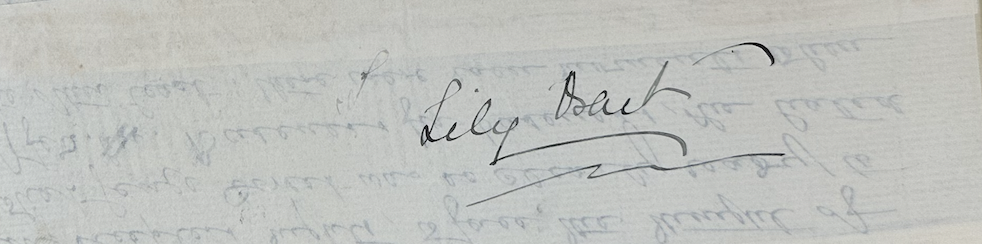
Going through the rejected variants for The House of Mirth & comparing them to the manuscript for the second time, some items stick out a bit differently. This is the one of the verso pages for Book 2, Chapter 6, in which Lily’s back in town in a small rooming house, with nowhere to go and no one to see. She’s just told George Dorset that she “knows nothing” about Bertha’s affair with Neddy Silverton and now, finding herself even more at loose ends than usual, starts thinking about images that “must at any cost be exorcised; & one of these was the image of herself as Rosedale’s wife.”

As she’s musing idly about erasing her identity and embracing her fate, here’s what Wharton wrote on the back of the page: “Lily Bart,” as if Lily herself is signing her name, with two underlined flourishes. It’s not part of anything else in the passage. It’s as though Lily, through Edith, is making her identity known.

Adventures with Edith: Gus Trenor, primitive man

Adventures with Edith, Book I, Chapter 13. This is the scene in which Gus Trenor has trapped Lily in his otherwise-empty house, and it is even more scary in the MS version, though that may be an artifact of the slow reading necessary for this part. Wharton rewrote this twice (manuscript with changes and typescript/manuscript with changes), with lots of crossouts, pasted-together strips, and alternate text on the backs.

I hadn’t fully appreciated before how much stagecraft Wharton puts into this scene: the drunken & angry Gus moves a chair in front of Lily and plops himself down in it, blocking her exit. He creeps up on her “with a hand that grew formidable.” And instead of making Lily “hear him out” as in the book, he’s now got what he wanted (Lily alone) and means “to make the most of it.”

In her anger, Lily had earlier made a satiric jab at Gus’s intelligence, and this calls forth the “primitive man from his lair.” She’s talked her way out of these situations before with wit, but now Lily’s terrified, frozen in place, afraid of the “mustering of vulture tongues” (just “tongues” in the book) if she calls for help.

As I was working on this part today, this scene reminded me of what Margaret Atwood said: “Men are afraid that women will laugh at them. Women are afraid that men will kill them.”

Biography Corner: Tracy Daugherty’s Larry McMurtry: A Life and McMurtry’s Books: A Memoir

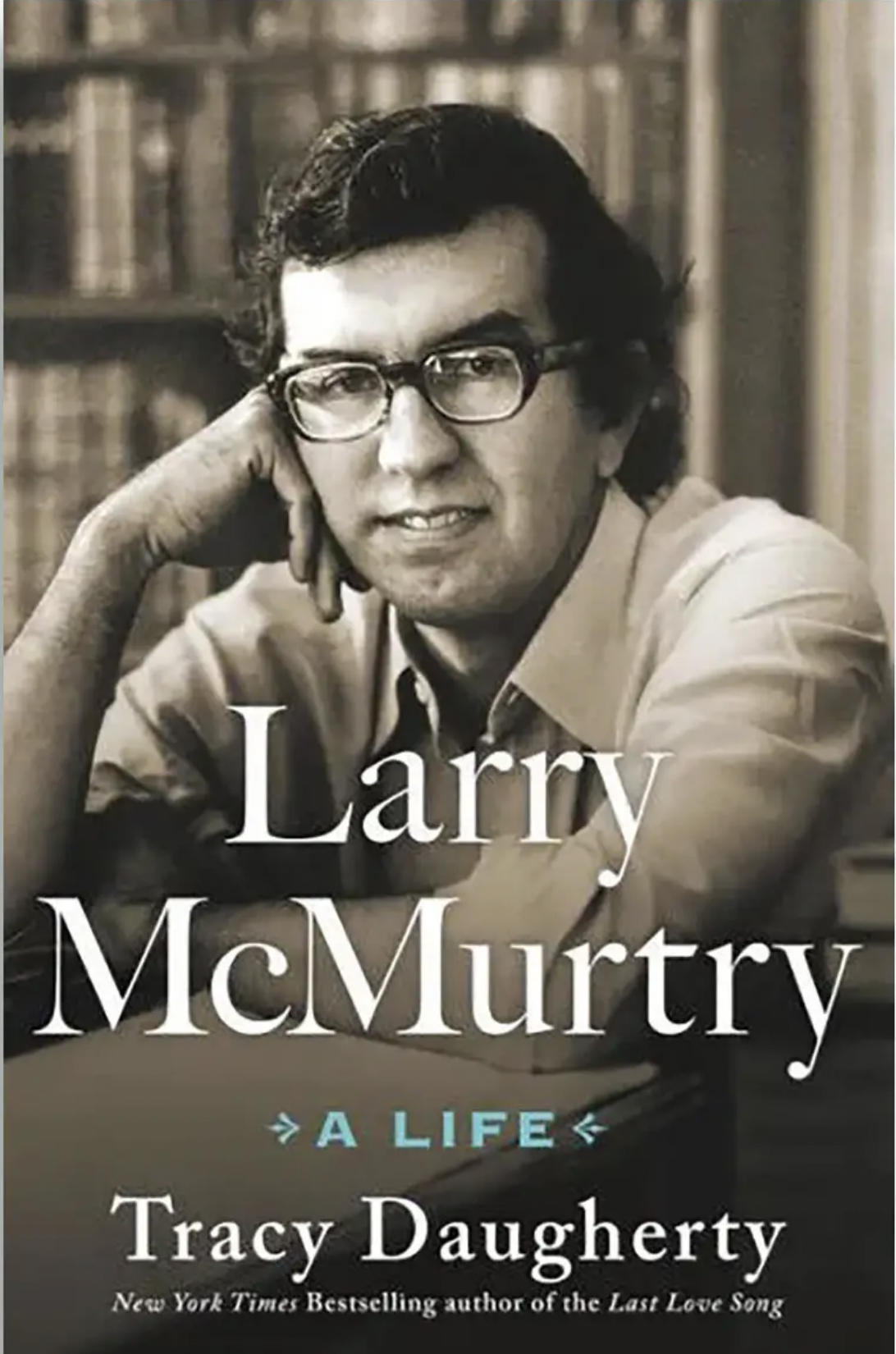
Tracy Daugherty’s Larry McMurtry: A Life (2023) is a terrific and evocative biography. As Dwight Garner says in The New York Times (source of the image), it’s “episodic” and “entertaining.” If, like me, you’ve only read a handful of McMurtry’s fiction and nonfiction (the Lonesome Dove books, The Last Picture Show, Texasville, Duane’s Depressed and some essay collections), Daugherty fills you in on what you’ve missed and also the books that he (and McMurtry himself) say you aren’t necessarily missing if you don’t read them.

This isn’t a “On June 20, 1963 he did such and so” kind of biography. Rather, through interviews, recollections by McMurtry, and knowledge of the spaces he inhabited, it gives you satisfyingly rounded impressions of–for lack of a better word–McMurtry’s general activities, headspace, and landscapes at various periods of his life: his career as a teacher, as a writer, and as a bookseller and book collector, the last of which seems to have been his real passion. It’s all interesting, from McMurtry’s early days in Texas through his friendships, fame, and bookstores. “Interesting” is sometimes a coolly neutral word, but it’s meant as praise here, for if you’ve ever read a biography that goes into exhaustive detail on the subject’s FBI files or chronicles a minute-by-minute and equally exhausting tale of the subject’s travels, you know that “interesting” isn’t guaranteed in a biography.

Daugherty discusses and seems largely to agree with McMurtry’s reputation as a novelist with a special talent for drawing women, a reputation he shares with John Updike. I’m puzzled by both of these, because McMurtry, like Updike, has two basic types of women in all the novels by him I’ve read:

  1. Somewhat spirited but downtrodden by circumstances, like Lorena in Lonesome Dove or Ruth Popper in The Last Picture Show (though not in Texasville, where she’s become a jogger, if memory serves, and learns to speak her mind).
  2. “Scary” women, like Lois Farrow in The Last Picture Show, Karla in Texasville, and Aurora in Terms of Endearment. These women are demanding, capricious, sometimes funny, and sometimes mean as snakes–and yet the men in the novels adore them for it and seem to enjoy their antics. They bring the drama, and the men eat it up, but why? Is it because the men around them are so taciturn and the culture so unforgiving that being mean as snakes is the only way the scary women can get their way and make themselves heard? Maybe it’s a cultural dance like the one that Rosemary Daniell describes in Fatal Flowers, where Southern men seem to adore and indulge the crazy in Southern women (I’m going from Daniell’s book, not my own perceptions) because they know the women have so little power otherwise. In Peter Bogdanovich’s superb movie version of The Last Picture Show, Lois tells Jacy that she’s not scary enough to bully Duane into being a success as she has scared Jacy’s father into being a success, so maybe “scary” is for McMurtry’s women the only route out of being downtrodden.

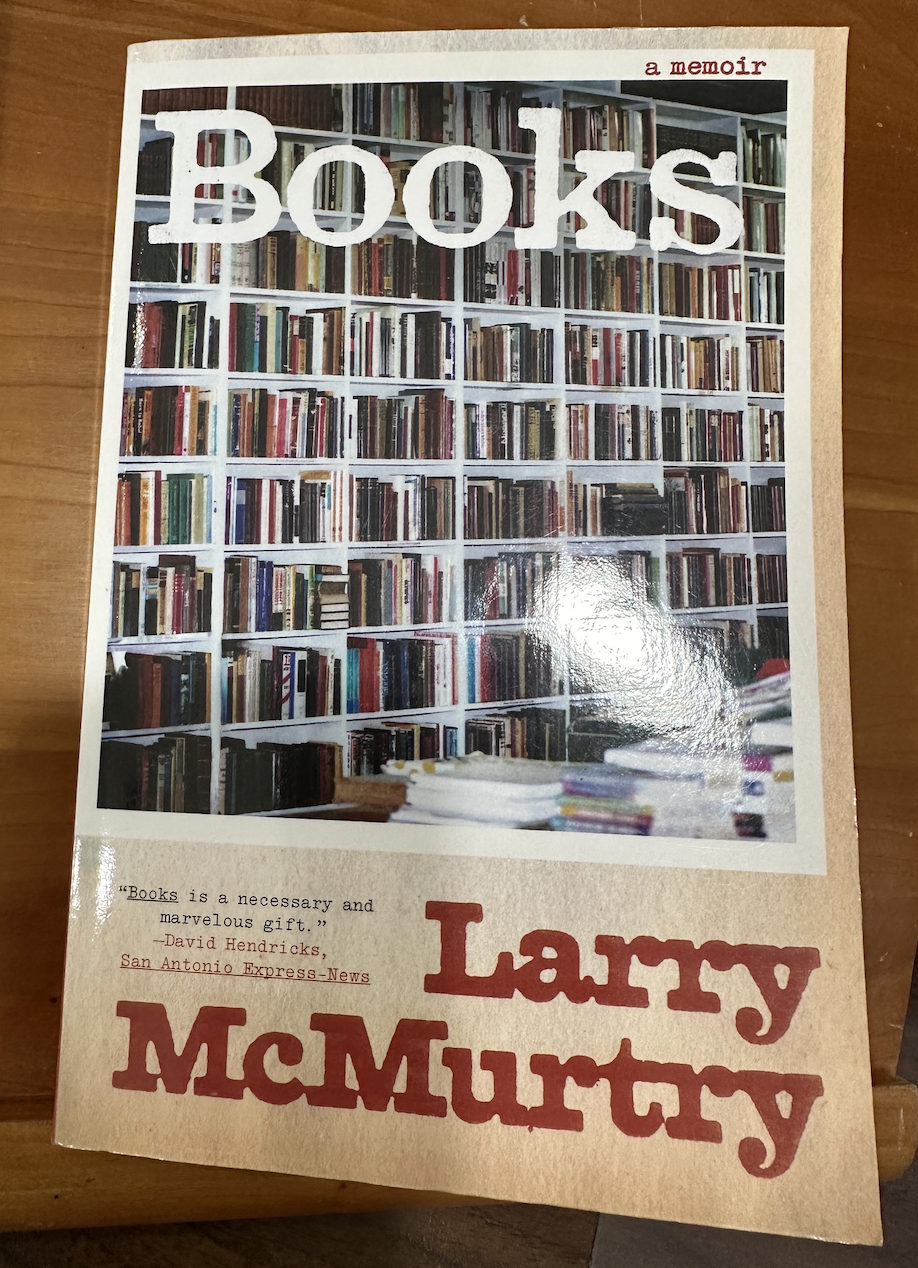
Reading Daugherty led me to ordering and reading McMurtry’s Books: A Memoir (2008); I’d read Walter Benjamin at the Dairy Queen some years ago. Books: A Memoir is McMurtry’s life as a reader and bookseller, told in 109 short vignettes. The New York Times review by James Campbell faulted this approach, saying that it’s more like notes to a memoir than a memoir.

But McMurtry was ahead of his time in this: think about Lauren Berlant and Kathleen Stewart’s The Hundreds or Maggie Smith’s You Could Make This Place Beautiful, both of which use the same form. Also, in our attention-challenged age, it’s a lot easier to read vignettes than long chapters. Because some phrases were repeated, I wondered whether these vignettes emerged from McMurtry’s famous morning writing routine as exercises to warm up as well as exercises in memory.

The writing routine: Daugherty tells us that McMurtry wrote on a Hermes 3000 typewriter, which McMurtry famously thanked in a 2006 Golden Globes acceptance speech for the screenplay of Brokeback Mountain (cowritten with Diana Ossana). McMurtry: “I wrote five pages a day for many years; then, as my fluency increased, I upped the pace to ten pages a day” (Books: A Memoir, 225). Daugherty adds this detail: after cataract surgery McMurtry continued his routine:

“McMurtry always felt that if he could capture the rhythm of a strong narrative voice, he could write as fast as he could type: the work was in his fingers and mind more than in his eyes. . . . He began at seven-thirty each morning. An hour and a half later, he’d be done.”

Adventures with Edith: Gus Trenor

Adventures with Edith: The reverse-engineering and transcription of variants in the galley proofs for Book 2, Chapters 9-14 is done, and let’s just say that some pages were easier to work on than others.

I’m back to Book 1, Chapter 8 (there is no MS for Chapter 7), and here are two treats from it. First of all, you EW people know that Edith Wharton’s grammar and spelling are perfect–in English, anyway, and probably in French, Italian, and German as well. As I told my students working on transcribing the unpublished EW: if you think she’s made a mistake, look again. It’s not her; it’s you. But in all these tens of thousands of words, I have found one misspelling: buoyancy, which she spells “bouyancy.” Raise your hands if you would probably misspell this, too–anyone? anyone?

Second: Gus Trenor. Wharton leaves in all the descriptions of his heavy, sweaty, red-faced diving into his food & general grossness, but she deleted this gem in the final book. Lily’s standing there looking at the wedding-present jewels and thinking “why should Evie Van Osburgh marry Gryce & get all the good stuff?” when Gus lumbers up “as impervious to her annoyance as a pachyderm to the shrinking of a trodden grass-blade.” The book leaves off at “annoyance,” so we never got the image of Gus as an elephant stomping all over that trodden grass-blade Lily. Whether that’s because the image is comical, or too on-the-nose, or at odds with the imagery of Gus as a carnivore only God and Mrs. Wharton now know.

Today in Adventures with Edith

Today in Adventures with Edith: I thought I would work on the galley proofs of the Scribner’s Magazine version for a while to take a break from the second pass collation of the MS. Unless I wanted to retype all five chapters (spoiler alert: I didn’t), this involves reverse-engineering a transcription of the galley proofs from the Scribner’s Magazine version by going line by line until they’ve been reconstructed & then inserting EW’s corrections. So far, so good.

All was well until I scrolled ahead and realized that there are TWO sets of corrected galley proofs. Wharton made one set of changes, turned it in, and then made a whole other set that doesn’t have any of the first changes listed. My favorite remark today was this one, left by a patient compositor: “To author: Many of the corrections made on this set of proofs conflict with those on previous set–returned herewith.”

House of Mirth Book 1, Chapter 6: tear at your heart & tear out your hair

What is simultaneously one of the most beautiful chapters in any novel and also a hot mess? Chapter 6 of The House of Mirth, that’s what. It’s the chapter where Lily and Selden walk in the woods at Bellomont, and Edith Wharton was obviously determined to get it just right. But did she have to number pages things like 89A, which comes after 99 but before 98, which appears 8 pages later after 102? And how about all those random passages on the verso pages, sometimes just a word or two, that also need to be put into place? It’s a good thing I like jigsaw puzzles.

This is my second pass through the manuscript working on collating & recording variants, and it’s still taking me hours. Is it worth it? You bet. 

See less

Editing House of Mirth: Lily’s last hours

Working on collating (spoiler!) Lily’s last hours today was so powerful. I’ve read HM many times, but reading it this way is entirely different. Every bodily sensation of her sinking into the drug-induced sleep is described at what seems an agonizing length, yet EW keeps making changes: is the sense of “warmth & pleasure” or–as she finally decides, “drowsy peace”?

But Wharton’s handwriting is her “fast” handwriting, when she’s clearly on a roll & making few changes. The last paragraph has almost no changes, especially to the last lines: “the recovered warmth flowed through her, she yielded to it, sank into it, & slept.”