Mark Twain Gives Advice on Conference Presentations

These excerpts from the new Autobiography of Mark Twain address “a new and devilish invention–the thing called an Authors’ Reading”  rather than a conference presentation, but Twain has some great advice about what not to do. These are from pages 383-384 in the print version, but you can read it online as well.

Twain had been asked to speak and foresaw disaster: “The introducer would be ignorant, windy, eloquent, and willing to hear himself talk.  With nine introductions to make, added to his own opening speech–well, I could not go on with these harrowing calculations.”

1. It takes a long time to create a readable short paper.

“My reading was ten minutes long.  When I had selected it originally, it was twelve minutes long, and it had taken me a good hour to find ways of reducing it by two minutes without damaging it.”

2. Time your presentation. Even Howells didn’t know this.

“Howells was always a member of these traveling afflictions, and I was never able to teach him to rehearse his proposed reading by the help of a watch and cut it down to a proper length. He [page 384] couldn’t seem to learn it. He was a bright man in all other ways, but whenever he came to select a reading for one of these carousals his intellect decayed and fell to ruin. I arrived at his house in Cambridge the night before the Longfellow Memorial occasion, and I probably asked [him] to show me his selection. At any rate, he showed it to me—and I wish I may never attempt the truth again if it wasn’t seven thousand words. I made him set his eye on his watch and keep game while I should read a paragraph of it. This experiment proved that it would take me an hour and ten minutes to read the whole of it, and I said ‘And mind you, this is not allowing anything for such[interruptions] as applause—for the reason that after the first twelve minutes there wouldn’t be any.’”

3. Keep it short.

“He [Howells] had a time of it to find something short enough, and he kept saying that he never would find a short enough selection that would be good enough—that is to say, he never would be able to find one that would stand exposure before an audience.

I said ‘It’s no matter. Better that than a long one—because the audience could stand a bad short one, but couldn’t stand a good long one.'”

4. Conference rooms can be stuffy.

“It was in the afternoon, in the Globe Theatre and the place was packed, and the air would have been very bad only there wasn’t any. I can see that mass of people yet, opening and closing their mouths like fishes gasping for breath. It was intolerable.”

5. Don’t belabor the obvious.

“That graceful and competent speaker, Professor Norton, opened the game with a very handsome speech, but it was a good twenty minutes long. And a good ten minutes of it, I think, were devoted to the introduction of Dr. Oliver Wendell Holmes, who hadn’t any more need of an introduction than the Milky Way.”

Biography Corner: John Hay’s Literary Network

John_Hay,_bw_photo_portrait,_1897I’m only up to the year 1895 in listening to John Taliaferro’s All the Great Prizes: The Life of John Hay, but it’s clear that what others are seeing as a bug in the biography is something I’d call a feature: its focus on the literary rather than the political side of Hay’s life.  Historians like Louis L. Gould in the Wall Street Journal and Heather Cox Richardson in the Washington Post have faulted Taliaferro’s lack of emphasis on politics, but for the literary historian, it offers a passing parade of nineteenth-century characters:

  • The Five of Hearts, including Henry Adams, the tragic Clover Adams, subject of a fine recent biography by Natalie Dykstra; and the mercurial Clarence King, whose amazing double life is told in Martha Sandweiss’s fascinating social history and biography of King, Passing Strange. 
  • The usual suspects: Lincoln, for whom (as anyone knows after seeing Lincoln), Hay served as a private secretary with John Nicolay; Garfield, Grant, James G. Blaine, McKinley, Mark Hanna.
  • Our old friend W. D. Howells, with whom Hay shared a lively correspondence as both men seem to have done with everyone else in the nineteenth century.
  • The beautiful and elusive Lizzie Cameron, for whom Hay, Adams, and a good portion of nineteenth-century masculine Washington seem to have carried a considerable torch (was she the “It Girl” of the Gilded Age?). She deserves a biography of her own.
  • Directly or indirectly: Mark Twain,  Henry James, and Bret Harte.  The latter’s success inspired Hay to write two popular dialect poems, “Little Breeches” and “Jim Bludso of the Prairie Belle.” 
  • And Constance Fenimore Woolson, the subject of Anne Boyd Rioux’s new biography project.  Hay was related to Woolson through Samuel Mather, and it was Hay who helped arrange and pay for her burial in Rome’s Protestant Cemetery. To Henry Adams, he wrote (I’m paraphrasing): “We buried poor Constance Woolson today. She did much good in her life, and no harm, and she had no more happiness than a convict.”

Hay’s The Breadwinners, which I read many years ago, is discussed at some length, as is the LIncoln biography and Hay’s poetry.

Charles Dudley Warner (1829-1900): Brief biographical sketch

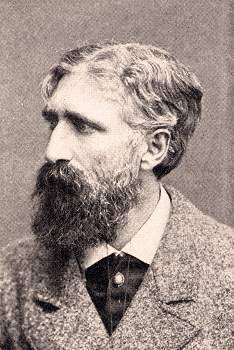
warner_cd_mtbThe following is a short biographical sketch of Charles Dudley Warner written a few years ago for a collection that was never published, and the sketch is now on the Charles Dudley Warner page at the American Authors site.

Charles Dudley Warner (1829-1900), author, critic, an editor, is best known today for his collaboration with Mark Twain on The Gilded Age (1873). Born in Plainfield, Massachusetts, on September 12, 1829, Warner worked on his guardian’s farm from ages eight to twelve, an experience that informs the memoir Being a Boy (1877).  After graduating from Hamilton College in 1851, Warner, hoping to restore both his health and his fortune, joined an engineering corps surveying lands in Missouri.  After returning east, he married Susan Lee (1838-1921) (http://www.harrietbeecherstowecenter.org/hbs/nook/warner.shtml) in 1856 and received a law degree from the University of Pennsylvania two years later.  He practiced law in Chicago before moving to Hartford and beginning his journalistic career in 1860. He was a founding member of the literary colony at Nook Farm, whose members included Harriet Beecher Stowe and Mark Twain.

Warner’s principal contributions to journalism are his editorship of the influential newspaper The Hartford Courant and his exploration of the essay as a genre.  In 1861, he assumed the editorship first of The Evening Press and then of The Hartford Courant, later consolidating the two papers.  During the Civil War, Warner contributed essays and sketches to the Courant, consciously choosing, according to Annie Adams Fields, to focus on lighter domestic fare that would distract readers from the conflict (http://www.public.coe.edu/~theller/fields/warner.html). This series of popular editorials, later collected as My Summer in a Garden (1870), established Warner as an essayist as well as an editor, one whose genial manner and mildly humorous style recalled the work of Washington Irving.  Backlog Studies (1873) continued this tradition, being ” a kind of apotheosis of home” that nonetheless prefigured some of Warner’s critical preoccupations.

Beginning with Saunterings in 1872, Warner also published nine travel books, some of which focused on Europe and the Middle East, such as In the Levant (1875) and My Winter on the Nile: Among the Mummies and Moslems (1876; rev. ed., 1881). Others provided an in-depth look at lesser-known areas of the United States: Studies in the South and West, with Comments on Canada (1889), On Horseback: A Tour in Virginia, North Carolina, and Tennessee, with Notes on Travel in Mexico and California (1888), and Our Italy, Southern California (1892).  Many of his books were first published as essays in the major literary journals of the day, including The Atlantic Monthly, Harper’s, and Scribner’s. His editorship of the American Men of Letters biography series, for which he wrote the initial volume, a biography of Washington Irving, cemented his reputation as a biographer as well as an editor.

In addition to the genre of the familiar essay, Warner was successful as a critic and novelist.  His essays in social and literary criticism generally favored social and literary reform, albeit of a limited kind.  Although in “A Study in Prison Management” (1885) he supported flexible, open-ended sentences, and in “The Education of the Negro” encouraged African American suffrage and education, he nonetheless argued that manual training and a designedly slow pace of racial assimilation was necessary.  As a literary critic, he succeeded William Dean Howells as the writer of the influential “Editor’s Study” column for Harper’s from 1894-1898, and his judgments in the column, as in his books The Relation of Literature to Life (1896) and Fashions in Literature (1902), sought to elevate Americans’ taste in literature.  After writing the satirical novel The Gilded Age with Mark Twain, Warner examined the rise and fall of a great family fortune through a trilogy of serious novels: A Little Journey in the World (1889), The Golden House (1894), and That Fortune (1899).  Achieving popularity during his lifetime but not the enduring critical respect given to figures like Twain and Henry James, Warner died in Hartford on October 20, 1900.

The Realist Fable: John Steinbeck and Harper Lee

“The Epic Battle for To Kill a Mockingbird in this month’s Vanity Fair tells the story of how a literary agent allegedly (and just put “allegedly” before all the statements here) convinced Harper Lee to sign papers that would remove control of her copyrights from her and grant them to the agent. John Steinbeck’s sons and their heirs had also had dealings with this agent, and, as a side note, had signed over powers of attorney to Elaine Steinbeck, Steinbeck’s third wife, who willed the copyrights to her own heirs and away from Steinbeck’s sons, Thomas and John. Elaine Steinbeck died in 2003,  and they have contested the provisions of her will.

The legal battles in the article made me segue into thinking about Harper Lee and Steinbeck, both of whom had written what might be called “realist fables” about American social problems of race and class. Both wrote books that are still schoolroom classics and good reads, too. To Kill a Mockingbird, which in 2009 generated a jaw-dropping $1.68 million in royalties for six months, might be more universally taught, but Steinbeck’s The Pearl, The Red Pony, and Of Mice and Men must still be taught in secondary schools. The Pearl, through which generations of students were introduced to symbolism, is a good example of the realist fable, and so is Hemingway’s The Old Man and the Sea, although Papa would surely have hated hearing it called that. It would be interesting to teach Tortilla Flat alongside his last, unfinished The Acts of King Arthur and His Noble Knights, too, both as historical and as realist fables.

If you’re talking about the complexity of Steinbeck’s novels, however, he’s at his best when he can temper the “realist fable” part of his writing with the more straightforward and direct address of what, for want of a better word, you could call “moral commentary.”  This sounds more negative than I mean it to be, but the books of Steinbeck’s where he does both–the fable and the lecture, alternating back and forth–are those that have held up best: The Grapes of Wrath, East of Eden, and The Winter of Our Discontent. 

In Grapes of Wrath, there are the stark scenes of desperation and fruit picking followed by commentary from Jim Casy and to a lesser extent Tom.  In East of Eden, the distinction is clearer between the allegorical Cain and Abel/Charles and Adam/Cal and Aron storyline and the dual strands of commentary by two “outsiders,” the philosophical Chinese servant Lee and the mystical Irish neighbor Samuel Hamilton. The Winter of Our Discontent has Ethan Allen Hawley’s first-person reflections on the series of moral tests that he encounters and the symbolic nature of the objects and the figures who tempt him (talisman, masks).

The alternation between “realist fable” and “moral commentary” sounds heavy-handed, but it’s not. At least for me, it’s what makes those books worth revisiting.