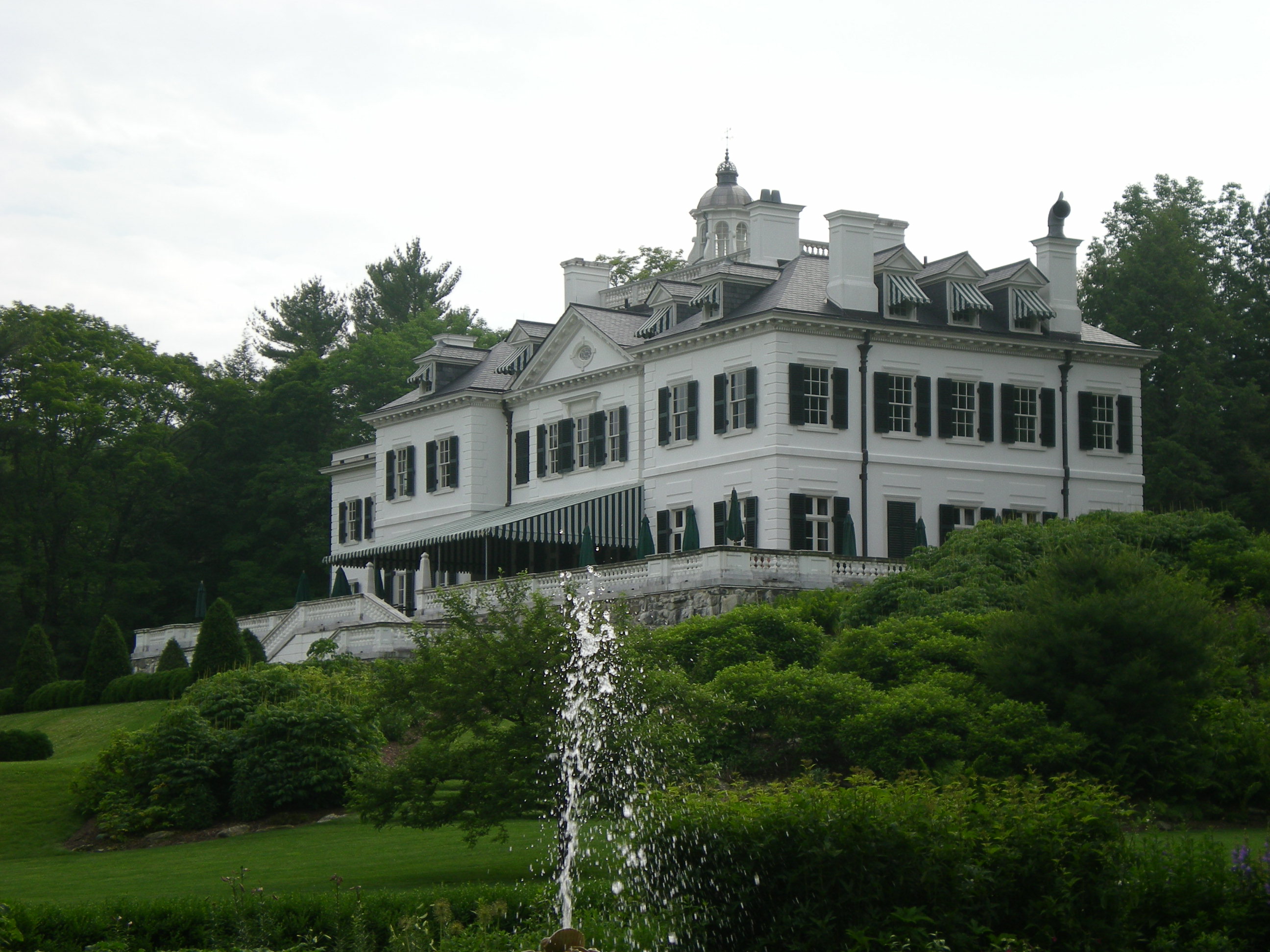
Edith Wharton’s Berkshires Home, The Mount

DSCN0535Cross-posted from the new Edith Wharton Society (http://www.edithwhartonsociety.org) site except for this photo of The Mount, which I took a year ago:

From NPR:

Gilding the Ages: Edith Wharton’s Berkshire Sanctuary

JARED BOWEN: Even today, Edith Wharton occupies a place as one of America’s leading literary ladies.  She was born into the upper crust of old New York in the mid-1800s—a member of high society who also exposed it through the prism of her pen. Wharton wrote more than 40 books in 40 years including “Ethan Frome” and “The Age of Innocence” for which she became the first woman awarded the Pulitzer Prize for Fiction. Today she is also remembered for her home, The Mount.  And if ever a house could serve as an autobiography, The Mount is it. Situated on a hill overlooking a lake in Lenox, Massachusetts, it was conceived by Wharton from the ground up.  She dreamed its location, guided its aesthetic principles and designed her elaborate gardens. It was in a sense, her own “House of Mirth”—which she wrote while living here.

Continue reading: Video and transcript at http://www.pbs.org/newshour/bb/entertainment/july-dec13/wharton_09-14.html
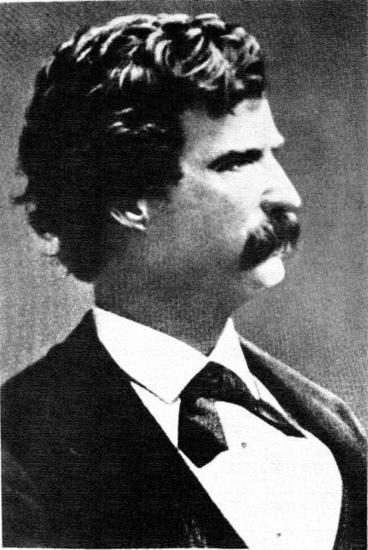
Mark Twain: A new discovery about his pen name

twainMartin Zehr’s “A New Theory Could Solve the Mystery of Mark Twain” in the Kansas City Star  profiles a discovery by Twain scholar Kevin Mac Donnell, who presented it at the recent Conference on Mark Twain Studies (the Elmira conference). 

From the article:

Mac Donnell made use of the Google Print Library Project, a search tool not available to earlier scholars. He was searching through 19th-century humor magazines when he came across a character in a burlesque sketch by the name of Mark Twain. It was in the Jan. 26, 1861 issue of Vanity Fair, a short-lived but widely read humor magazine of the era Twain is known to have read.

The anonymously published sketch in which the character appears, titled “The North Star,” is a send-up of Southerners at a nautical convention attempting to address the nagging problem of compasses always pointing north.

Successive speakers in the sketch, including Mr. Pine Knott, Mr. Lee Scupper, Mr. Mark Twain, Mr. Robert Stay and Mr. Rattlin, whose names are derivatives of sailing terms, gripe about the problem. The Civil War is about to erupt and will close the Mississippi River, ending Sam Clemens’ piloting career. As used in the sketch, the name Mark Twain is an indication of shallow water for an ocean-going ship, and, by inference, a person lacking depth.

Mac Donnell’s exposition, which appears in a detailed version in the current edition of the Mark Twain Journal, includes the observation that Charles Farrar Browne, aka Artemus Ward, a print and standup humorist Twain admired, was then a staff writer for Vanity Fair.

Mac Donnell’s research fills an important gap in the story by suggesting Clemens’ likely familiarity with the  piece two years following its publication.

Media History Digital Library

photoplay3334movi_0017

Colleen Moore in Her Wild Oat

The Media History Digital Library (http://mediahistoryproject.org/) has expanded its holdings in film magazines to include Variety from 1905-1926 and a host of others from all parts of the moviemaking industry, from technology to fan magazines. Here’s a partial list just from of the early cinema journals:

Exhibitors’ Times (1913)
Film Fun (1916-1926)
The Film Index (1910)
The Great Selection: First National First Season (1922-1923)
The Implet (1912)
Motion Picture Story Magazine (1913)

Motion Picture Studio Directory and Trade Annual (1916-1918)
Moving Picture Weekly (1916-1918)
Moving Picture World (1907-1919) – NOW COMPLETE FROM 1907 TO JUNE 1919!
National Board of Review Magazine (1926-1928)
The Nickelodeon (1909-1911)
The Photoplay Author (1914-1915)
The Photo-Play Journal (1916-1921)
The Photo Playwright (1912)
U.S. vs. Motion Picture Patents Company (1912-1913)
Variety (1905-1926)
The Writer’s Monthly (1916)

Some of these are at archive.org, but the organization at the Media History Digital Library makes them far easier to find. If you write about early film and don’t know about this resource already, it’s well worth a visit.