Should you be required to join Facebook to see public history posts?

screen-shot-2017-02-03-at-10-54-22-am

Maybe this happens to you: you’re taking a break and looking at Twitter, and you see a tweet about a Call for Papers or an interesting history post. So you click on the link, and you get the screen above.

Are these public posts? No, they’re private ones, behind the wall of Facebook. Just because Facebook is widely used (yes, I have an account, too) doesn’t mean it’s an open source for information.

Sure, you could log in,  if you don’t care about having your interests and clicks and data measured, which I don’t especially on FB.  That’s the Mephistophelian bargain you make when you sign up for Facebook; as the old saying goes, if you’re not paying for the product on the internet, you ARE the product.

It’s one thing when the Association for Cat Necklace Distributors or some such thing wants to keep its organization behind the Facebook wall.

But when it’s supposedly public information? Or a supposedly open scholarly society? That’s irritating.

So if you see me retweeting, with an open link, the closed information and calls for papers that pass through my Twitter feed, that’s why.

Prophetic Voices: Sinclair Lewis

lewisSinclair Lewis, Jack London, Sui Sin Far/Edith Eaton, Paul Laurence Dunbar, Edith Wharton, Kate Chopin, Theodore Dreiser, Stephen Crane, Upton Sinclair, Mary Austin, Frank Norris. Were they prophets without honor in their own country?

Back in the mid 20th century, when the world was young and New Criticism ruled, they were all sort of . . . well, political, and everyone “knew” that Art was never Political but a well-wrought urn. The closer to modernism you could get on a sliding scale, the greater you were as an artist. Maybe Crane is sort of like Gertrude Stein! Maybe Wharton is like Henry James!

wharton1930s

Dreaming of being Henry James? Nope.

Except that art isn’t disinterested but is always political, as critics since have pointed out. And the works you may have read by them, if you read them at all, were carefully curated to be Art rather than Politics.

This issue comes up now because all of a sudden people are rediscovering Sinclair Lewis’s It Can’t Happen Here. But he wrote a lot of other good stuff, too, as did all the writers listed above, all of whom are well known today but often for a few works.

I started this post meaning to talk about them all, but there’s so much to say that this list will be only about Lewis; I will write about the rest later. I’ve read all his novels except The Job, many (Main Street, Babbitt, Dodsworth, Arrowsmith, Ann Vickers, Elmer Gantry, Cass Timberlane) more than once, though I couldn’t honestly tell you much about Gideon Planish or some of the other later ones.

You can also go to the Sinclair Lewis Society site for information: https://english.illinoisstate.edu/sinclairlewis/

Say you want to read or teach a Sinclair Lewis with some social or political relevance. I’m including the film versions, too.

It Can’t Happen Here, about a homegrown fascist takeover of the U. S., is popular right now.

annAnn Vickers: Feminist social worker with an honorary doctorate in sociology works in a settlement house, tries to reform a Southern prison, fights capital punishment, has an unhappy love affair and decides to have an abortion, and finally falls in love with a judge and decides to live with him when his wife won’t give him a divorce. Oh, and everyone calls her “Dr. Vickers.”  The Pre-Code movie version stars Irene Dunne; you can read a good discussion of it here (the source of the image).

imarriedadoctor1936_ff_188x141_052020100846Main Street (1920): The novel about Midwestern small-town America that made Lewis’s reputation, with a dissatisfied heroine who tries to reform a town that thinks she’s the one who needs reforming. It was made into a movie called I Married a Doctor, but the movie doesn’t convey the depth of the book. Image courtesy TCM.

Babbitt (1922): Begins with 24 hours in the life of a real-estate salesman (“Realtor!” I can hear Babbitt yelling) and then shows his growing anomie and disillusionment with conformity. He turns down the right-wing Good Citizens’ League and searches for his idealistic roots, only to–well, you’ll have to read it. Edith Wharton admired this book. The 1934 Warner Brothers movie stars Guy Kibbee as Babbitt.

elmer-gantryElmer Gantry (1927): Popular hypocritical evangelist (character based on Billy Sunday) who preaches what he definitely doesn’t practice and lives very well on the offerings from his flock. The 1960 movie version takes a lot of liberties with the plot but won Burt Lancaster an Academy Award. (Image link)

 

Arrowsmith.jpgArrowsmith (1925): An idealistic doctor-researcher, Martin Arrowsmith, faces incredible pressures from those who don’t believe science is important and discovers a “bacteriophage” to fight a tropical plague. Lewis turned down the Pulitzer Prize he was awarded for this novel. The fine 1931 movie version directed by John Ford and starring Ronald Colman is worth seeing, especially for its portrayal of Arrowsmith’s equal partnership with an African American doctor from Howard University.
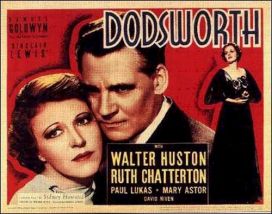
dodsworthDodsworth (1929). Car manufacturing giant Samuel Dodsworth and his wife, Fran, leave their midwestern city of Zenith (fictional location of many of Lewis’s novels) and travel to Europe, where they try to acquire culture in different ways, Sam through visiting places and reading guidebooks, and Fran by finding men to tell her that she looks and is young.

There’s a lot more to it than this, however, including some discussions of Henry James & W. D. Howells as well as broader meditations on American exceptionalism and expatriate living. Fun facts: Dorothy Parker admired the ending tremendously, though she wasn’t crazy about the rest of it, and Lewis dedicated the novel to Edith Wharton.  The 1936 movie adaptation directed by William Wyler, with Walter Huston, Ruth Chatterton, and Mary Astor, is based on the stage play and is superb.
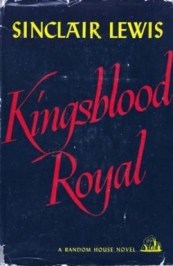
kingsblood_royalKingsblood Royal (1947). The racial dynamics of this are problematic now but were courageous in its day (1947). Neil Kingsblood discovers that he has an African American forebear, a coureur du bois, and defiantly confronts his racist neighbors, culminating in his standing down a white mob.


MLA Humanities Commons

screen-shot-2016-12-06-at-7-48-35-am

Figure 1. Humanities Commons offers you space to post your work and also a peaceful, forest-like atmosphere if you choose that header.

The Site Formerly Known As “MLA Commons” is now Humanities Commons (http://hcommons.org). It’s a user-friendly space to share your work rather than at Academia.edu.

I had already moved my work to the WSU Research Exchange and had asked whether links from research exchanges could be used in MLA Commons; Kathleen Fitzpatrick had tweeted back “not yet,” so maybe this new iteration will have that as a possibility.

In the meantime, I’m uploading my work–well, all that it’s legal to post–into the CORE section of Humanities Commons as well as in the WSU Research Exchange. As with all new spaces and technologies, there’s some duplication of effort (think about the evolution from vinyl to cassette to CD to downloads in music).  It’s a little like Tommy Lee Jones in Men in Black seeing a newer, smaller CD format and saying, “Guess I’ll have to buy The White Album again.”

It’ll be worth it, though, for the possibility of sharing work in a broader space.

#Hamilton’s Eliza, subjunctive mood

mrs_elizabeth_schuyler_hamilton_web-jpg__800x600_q85_cropAbout #Hamilton and grammar, not American literature.

When you listen to the soundtrack of Hamilton repeatedly, features that you hadn’t noticed at first leap out at you.

For example, in “Guns and Ships” Burr sings, “He’s constantly confusing, confounding the British henchmen / Everyone give it up for America’s favorite fighting Frenchman!”

marquis_de_lafayette_2

America’s favorite fightin’ Frenchman

Chorus: “Lafayette!

Lafayette:I’m takin this horse by the reins makin’
Redcoats redder with bloodstains

And so on.

Rising Notes Ask the Question

The chorus repeats this five times, always on rising notes (I don’t know the musical term for it), as though asking a question.

Falling Notes Give the Reply

Then, when Lafayette says “there’s someone else we need” and Washington says, “I know,” there’s this:

Washington and Chorus: “Hamilton!”

This is also repeated 5 times and interspersed with the reasons, but in a series of falling notes.

We’ve heard the question and the first part (“Lafayette!”) in a series of rising notes.

hamilton.jpg

“You called? I’ve got this.” Image from thefederalistpapers.org

The falling notes and the repetition tell us that Hamilton is the answer.

Eliza, Subjunctive and Indicative Moods

Eliza’s lyrics, too, are carefully constructed. Her character is all about the present, as she constantly reminds Hamilton. Her key phrase is  “look around, look around, at how lucky we are to be alive right now” in contrast to Washington’s and Hamilton’s simultaneous past and future perspectives (“history has its eyes on you” for Washington; “this is the only way I can protect my legacy” from “Hurricane” for Hamilton).

In Act I, even without the subject of triple uncertainty in “Helpless”–she’s not sure first what Angelica’s going to do, next what Hamilton’s going to do, and finally what her father’s going to do–her speech patterns show this uncertainty.

Eliza lives in the subjunctive mood, which uses “if,” “should,” “could” and other such words to express  a wish or condition contrary to fact. Think about all the times she expresses herself this way:

In “That Would Be Enough”:

And if this child
Shares a fraction of your smile
Or a fragment of your mind, look out world!

In “Non-Stop”:

And if your wife could share a fraction of your time
If I could grant you peace of mind
Would that be enough?

By Act II, however, she’s past it. In “Take a Break,” she isn’t tentative about asking Hamilton to “go upstate,” and by the time of “Burn,” she uses the subjunctive differently.

She recalls the past (“when you were mine”), scorns the idea of a legacy (“you and your words obsessed with your legacy”) by burning his letters, and uses one more subjunctive, not so tentatively this time, in the last line of the song:

“I hope that you burn.”

By her last songs, “Best of Wives and Best of Women” and “Who Lives, Who Dies, Who Tells Your Story,” Eliza’s totally in the indicative mood rather than the subjunctive. Her verbs are active and direct rather than tentative:

“Best of Wives and Best of Women”

“Well, I’m going back to sleep.”

“Who Lives, Who Dies, Who Tells Your Story”

“I raise funds”

“I speak out against slavery”

“I established the first private orphanage in New York City.” [this is the lyric as printed, although it sounds as though she’s saying “establish,” which would make the tenses more consistent.]

Hamilton has gotten a lot of press and praise for its innovative lyrics, its allusions, its uses of various musical forms, and so on, but it’s clear that it keeps that same level of consistency and innovation right down to its use of grammar.

Ahab’s backstory, Hollywood-style (1926)

sea_beast_film_still_6In which Ahab acquires a love interest, a last name, and a half-brother, not in that order.

The Sea Beast, an adaptation of Moby-Dick, was a huge hit for John Barrymore and for Warner Brothers in 1926. The cast list does not show Ishmael, but it does show Ahab’s half-brother and rival for the affections of Esther Harper, “a minister’s beautiful daughter,” played by Dolores Costello, soon to be Mrs. John Barrymore, and, much later, grandmother of Drew Barrymore.

The Sea Beast retains characters such as Queequeg and Fedallah, the latter played by Sojin Kamiyana, although Winnifred Eaton Reeve (Onoto Watanna) had described his part as being a “coolie” in a 1928 interview with him. 

In Moby-Dick, Ahab explains his motivation to Starbuck as follows:

All visible objects, man, are but as pasteboard masks. But in each event–in the living act, the undoubted deed–there, some unknown but still reasoning thing puts forth the mouldings of its features from behind the unreasoning mask. If man will strike, strike through the mask! How can the prisoner reach outside except by thrusting through the wall? To me, the white whale is that wall, shoved near to me. Sometimes I think there’s naught beyond. But ’tis enough. He tasks me; he heaps me; I see in him outrageous strength, with an inscrutable malice sinewing it. That inscrutable thing is chiefly what I hate; and be the white whale agent, or be the white whale principal, I will wreak that hate upon him.

But Warner Brothers, probably correctly deducing that something a little less metaphysical and “inscrutable” would be likely to bring more patrons into the theater, went with something more familiar to audiences: a love triangle, a vengeful brother,  and a happy ending in which Ahab gets over that obsession with striking the sun if it insulted him and all that.

AFI Catalog Description:

Ahab Ceeley and his half brother, Derek, are rivals for the hand of Esther Harper, a minister’s beautiful daughter. Because Esther favors his brother, Derek pushes Ahab overboard on a whaling trip; Ahab’s leg is chewed off by Moby Dick, a white whale; and he returns to Esther a broken and embittered man. Ahab, believing that Esther no longer loves him, becomes captain of a whaler and obsessively sets out to kill Moby Dick. Ahab learns of Derek’s treachery and, after killing the whale, kills Derek. Ahab return to New Bedford and, his obsession gone, settles down with Esther.

(Incidentally, I pity the poor high school students in 1926  who thought they’d save a little time by basing their book reports on the film version.)

You can see a clip from The Sea Beast here: https://www.youtube.com/watch?v=VVKsRIvSrkk

barrymoremobydickThe movie proved so popular that Warner Brothers made it again, four years later, in what people did not yet call a “reboot” of a “franchise.”
Here’s John Barrymore again, with all the original added features–love interest, vengeful brother–and an added mustache. Queequeg is played by the famous African American actor Noble Johnson, but Fedallah (and Sojin Kamiyana) is gone from the cast list. The love interest, now played by Joan Bennett instead of Dolores Costello, is still a minister’s daughter, this time the child of Father Mapple, who gives the famous sermon early in the novel.

In this 1930 ad from Motion Picture Classic, the film was still sporting the book’s title, Moby Dick (minus the hyphen in Moby-Dick) and some semblance of its original plot:

“Can he win revenge against this awful enemy–or will he perish in the giant maw that has been the graveyard of a hundred men before him?” There’s even a pod of spouting whales, though they’re dwarfed by John Barrymore’s famous profile.

The thing is, though, that in both these versions the white whale is clearly an instrument (Ahab’s “agent”) and not the entity responsible for the action (Ahab’s “principal”). He’s not to blame for taking off Ahab’s leg; it’s the brother’s fault for pushing Ahab overboard. The white whale acts in accordance with its nature, as Mark Twain would say.  Does this render Starbuck’s statement that Ahab’s desire for revenge is “blasphemous” any more or less true? Does Ahab’s quest make more sense if the backstory is a love rivalry?

If you want to challenge yourself with some questions on Moby-Dick, here are some to get you started: https://public.wsu.edu/~campbelld/amlit/mddq.htm

Read the New York Times review of The Sea Beast: http://www.nytimes.com/movie/review?res=9E00E7DA1231EE3ABC4E52DFB766838D639EDE

Murder on her Mind: Did Edith Wharton write about Lizzie Borden? (part 3 of 3)

allthisandheaventoo1940_574_678x380_11082013091638

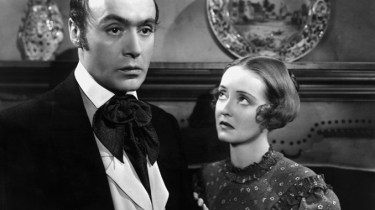
Charles Boyer and Bette Davis in All This and Heaven, Too (1940). Picture from TCM.

If Edith Wharton  was so enthusiastic about writing the Lizzie Borden story, why didn’t she finish the play Kate Spain? 

The key to this is what she told her sister-in-law and friend, Minnie Jones, in the letter dated March 9, 1935. At this point, she had written (but not published) “Confession,” and she had also written the first act of what she calls “the Lizzie Borden play.”

But Wharton also worried that “it was more than likely that it had already been used.” Her friend Edward Sheldon, the playwright, told her that it had been done, she claimed, and so she decided not to finish the play.

The story “Confession” was another matter;  as she told Minnie Jones, “I do not think the story will suffer much from its Borden origin, as you will have seen by this time that it is of no importance in my fable, and my young woman could quite as well have murdered an intolerable husband” (Letters 584). In “Confession,” the narrator wonders whether Kate could be “the murderess of her own father”  (Lewis, Collected Stories 2: 817), but the other details differ from the case.

screen-shot-2016-10-13-at-8-10-35-am

Lizzie Borden listens to testimony about the burning of the dress. From trial accounts of the time in The Lizzie Borden Sourcebook (at the link).

This helps to explain one mystery: why is Kate Spain so much more explicit about the murder than “Confession”? If Wharton intended the story to be a more general “fable” rather than a treatment exclusively of the Borden story, the ambiguity makes sense.

Kate Spain has many specific details, including a piece of stained calico burned around the edges and a deleted segment stating that the father had been killed while lying on the sofa. These references show Wharton’s familiarity with the case. If you’ve read any of the books about the case, for example, you’ll recall that Borden is supposed to have burned a calico dress in the stove. “I am going to burn this old thing up; it is covered with paint,”  she said, which apparently didn’t influence the jury’s decision.

allthis

Sheldon didn’t stop at telling Wharton that the Borden case had been overdone, however; he suggested instead that she use “the Praslin murder instead.”  The “Praslin murder” was a famous murder case involving the Duc de Choiseul-Praslin, whose wife, Fanny Sebastiani (by whom he had 10 children), was apparently passionately jealous of him and had recently fired the family’s governess, Henriette Deluzy-Desportes, due to her suspicions.  On 18 August 1847, the Duchesse was found bludgeoned and stabbed to death; the Duc maintained his innocence but, while awaiting trial, committed suicide.  The governess, Henriette Deluzy-Desportes, was briefly jailed in the murder but released. She became the wife of the minister Henry Martyn Field, brother of Cyrus Field (whose company laid the first Atlantic cable), and the couple later lived in Stockbridge, Massachusetts.

In her letter to Minnie Jones, Wharton adds, tantalizingly, that she “began a novel on the Praslin case two or three years ago, which alas I did not finish; and last year I saw that some one else had used the subject, though probably quite differently, as I had intended the story to begin only after the governess arrives in Stockbridge” (Letters 584). In addition to being the setting for the real story, Stockbridge was a natural choice for Wharton: she had lived near there in Lenox at The Mount for ten years, and she had set Ethan Frome and Summer in the same region.

The editors of the letters, R.W.B. Lewis and Nancy Lewis, don’t give a title for this unfinished Praslin novel by Wharton. They do, however,  supply a name of the presumed other novel on the subject, implying that they thought this was the treatment to which she referred: Rachel Field’s All This and Heaven, Too, which was made into a movie starring Bette Davis and Charles Boyer in 1940. Rachel Field was the great-niece of Henriette Deluzy-Desportes, the governess at the center of the case. I’ve read the novel  (the source of the brief summary of the murder case above), and it is sympathetic–very–to her great-aunt’s position.

Here’s another mystery, though: All This and Heaven, Too was published in 1938, the year after Wharton’s death. Was this the version that Wharton referred to, and if so, how had she seen it by 1934, the “last year” when she mentioned seeing something else about the subject? If it was in French, she might have read it but wouldn’t have been deterred from writing about it, because she was looking at the American market for her works.

I’ll have to look more closely to see if there’s a serial version (haven’t found one yet), but another possibility is that someone at Macmillan, which was Wharton’s publisher and also Field’s, tipped her off about it.

That’s all for now, but the search continues for a lead on the Praslin novel that Wharton saw.

Part 1

Part 2

Part 3

MLA Style Guide, 8th Ed.: a lighthearted first impression

mla8th

Figure 1: New and Improved.

Edited to add:  About #7 below: I even made a chart a few years back, when I was writing “Fiction: 1900 to the 1930s” for American Literary Scholarship, to indicate which periodicals were numbered by issue and which by volume: http://public.wsu.edu/~campbelld/journals.htm

Now that the requirement is back in the 8th edition, use it in good health.

***

I recently cracked open the new MLA Style Guide, 8th edition. What follows are a series of decidedly lighthearted and not at all scholarly reflections, so if you’re looking for something serious, ignore this post.

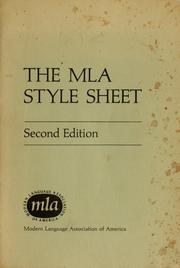
With the MLA Style Guide, 8th Edition, MLA Style is going back to its roots as a pamphlet, back when it was known as the MLA Style Sheet. I’m kidding, of course, but the 8th has slimmed down considerably.

But it apparently inspires strong passions, including Dallas Liddle’s “Why I hate the MLA Handbook” and Dallas Rossman Regaignon’s “Why I love the MLA Handbook.”Their reasons are basically the same: they hate/love its new flexibility.

The 8th edition has a philosophy of “containers,” which attempts to demystify the style for students and the rest of us. Herewith a few observations:

stylesheet

Figure 2. Where it all began, complete with spiffy Dewey Decimal number at the Open Library

1. Examples for in-text citation (which are very few) look just like the old MLA Handbook styles.

2. But if you look at the examples for documentation and Works Cited, your first thought may be, as mine was, “Cool! Commas, commas, commas for everything. This is like The Chicago Manual of Style 16! What an exciting meeting of the minds for the two competing styles to get together.”

3. URLs are back, but the detestable “Print.Print.Print” is gone.

4. There’s a whole list of “optional” elements, though, and the language used is user-friendly and sort of touching in its “you’re the Decider, so you decide” prose.

  • Book series title? You decide (p. 52).
  • Date of access for a web site? You decide (p. 53).
  • Place of publication (in the index under, for some reason, “cities of publication”)?  Since this “serves little purpose today” (51), yes, indeed–you decide.

5. What’s not optional: spell out “translated by, edited by” and so on in the Works Cited entry, same as in Chicago Manual of Style 16 14.78 and following, except that Chicago abbreviates them in notes. MLA does not.

6. And “pp.” is back, in the Works Cited.

7. But the most heinous and bedevilling of distinctions, as pointless as ever, is back: having to put in the issue number if a periodical is paginated by number and having to omit it if it is paginated by volume.

It’s right there on pp. 39-40.  If the journal is paginated by ISSUE, include the issue number. If it’s paginated by VOLUME, don’t.

How many hours have been wasted on trips to the library because you–okay, I–forgot to check this detail? Say you have an issue from January 1901. How do you know, except by looking at previous volumes, whether this is numbered by ISSUE or by VOLUME?

Answer: You don’t. You can’t. So if you didn’t write it down, back to the library you go to find out.  That’ll teach you–or, well, it taught me–to check this detail every single time.

mlaexample

Figure 3. The 7th edition and its sweet, agnostic system for volume.number.

The MLA mercifully axed this one in the 7th edition. In section 5.4.2, even their entries for paginated-by-year periodicals like Critical Inquiry use the issue number. Issue numbers for all!

I thought that the 7th edition had put a stake through the heart of this rule forever. But as if rising from the grave, the undead Volume.Number (only if paginated by issue, remember!) rule is back. In contrast,  Chicago 16 14.18 says that the number “may be omitted” but doesn’t prescribe it.

Summary: MLA has worked hard to simplify its rules, and ultimately we’ll all follow whatever they tell us anyway, as best we can. Our opinion is a moot point, or, as Joey said on Friends, “a moo point. You know, like a cow’s opinion: it doesn’t count.”

Anything that brings the two major style guides in English closer together is a step in the right direction.

Some serious sites that describe the differences:

MLA: https://www.mla.org/MLA-Style/What-s-New-in-the-Eighth-Edition

Purdue OWL: https://owl.english.purdue.edu/owl/resource/747/22/

https://www.easybib.com/guides/citation-guides/mla-8/mla-7-vs-mla-8/

Alexander Hamilton, Gertrude Atherton, and John O’Hara Cosgrove

Screen Shot 2016-07-28 at 11.42.20 AMI’ve recently been reading through some letters from John O’Hara Cosgrove (link) , the editor of Everybody’s Magazine, to Owen Wister, the author of The Virginian (1902). My principal interest is Cosgrove’s connection with Frank Norris, who had worked at The Wave when Cosgrove was its editor, and his thoughts on Jack London, but this excerpt gives a good sense of what editors–or at least this editor–was thinking might sell in 1902.

In 1902, the California novelist Gertrude Atherton (today best known for her novel Black Oxen, 1922) published The Conqueror: Being the True and Romantic Story of Alexander Hamilton (New York: Macmillan and Company, 1902). By the time she republished it in 1916, the book had acquired a slightly less sensational title: The Conqueror: A Dramatized Biography of Alexander Hamilton (New York: Frederick A. Stokes Company, 1916).

Responding to the book, Cosgrove pitched Wister, as he often did, about participating in a series of articles “treating real men as though they were characters in fiction”:

I have just been reading Mrs. Atherton’s book on Alexander Hamilton. The form, which is really a departure, gave me a very clear impression of the subject’s individuality.  It represented a form of treatment that I have often urged using and treating real men as though they were characters in fiction.  I mean using the fiction method to project the personality of the individual.  This seems to have been done very well by Mrs. Atherton, and if we could have in the magazine a series of five-thousand word interviews with Washington, Jefferson, Madison, Adams, Daniel Webster Henry Clay and their like, selecting a strenuous moment in their careers & putting in an appropriate background, it would make a capital series.  Mrs. Atherton has the Hamilton one under way. (23 July 1902)

But apparently what worked well for a “romantic story” did not translate as well into the type of fictional interview that Cosgrove had in mind:

Entre nous, Mrs. Atherton tried Hamilton for us, and turned out a mighty poor thing, which I had to return.  It was slap-dash, rather common, frivolous, and quite outside the idea—rather crude journalism, in fact.  It is mighty difficult to get that sort of thing accomplished just as it must be done. (6 August 1902)

“Mighty difficult,” indeed. This raises a question for all those who would undertake biography or speculative biography: How much more sensationalism or sentimentality did Atherton’s unpublished draft contain to be labeled “common, frivolous” and “crude journalism”?

Oh, W. D. Howells. If only you were right.

Reasons to support the humanities, number eleventy-trillion:

“You have often said that the novel is a perspective,” observed the other man. [Note: Stephen Crane, who was interviewing Howells.]

“A perspective–certainly.  It is a perspective made for the benefit of people who have no true use of their eyes.  The novel, in its real meaning, adjusts the proportions. It preserves the balances.  It is in this way that lessons are to be taught and reforms to be won.  When people are introduced to each other, they will see the resemblances, and won’t want to fight so badly.”

from “Howells Fears Realists Must Wait”

Marginalia in James Lane Allen’s Summer in Arcady: A Tale of Nature

2016-02-23 12.54.59Today I’ve been rereading James Lane Allen’s Summer in Arcady: A Tale of Nature (New York: Macmillan and Co., London: Macmillan & Co., Ltd., 1896) and noticed something that I hadn’t remembered, something not covered in the yellow Post-Its that mark the content–marginalia.
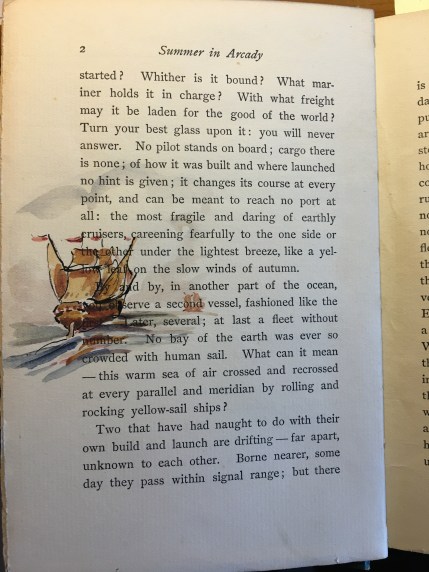
These pictures appear only in the Prelude, not elsewhere in this volume, but as the bookseller noted, “Someone has added skillful watercolor illustrations to pages 1, 2, & 4.”

The illustrations match the text, too; they’re not random doodles.

Here they are:

2016-02-23 12.43.14

2016-02-23 10.07.35

2016-02-23 12.43.50