Laptops in the classroom? A reasoned response.

Short answer: yes, if it works for your teaching, and no, if it doesn’t. Used selectively, they can really help. But “selectively” has proven to be the key, at least in the classes I teach.

I’ve been teaching with technology for a long time and have adopted new technologies as they emerged.  When laptops started being common in classrooms circa 2004, I took a wait-and-see approach.

“Wait” is a lot of what I did, actually.

Me: “Student, what did you see in this passage?”
Student: [Looks up from laptop and stares blankly at me.]
Me, repeating the question: “Student, what does X mean by this phrase?”
Student: “What? Where are we? I didn’t hear the question.”

Buoyed by the hype surrounding laptops in classrooms–because at heart I’m a tech enthusiast–I waited. I watched this process unfold for seven years before addressing it.

I watched student participation slow down. I wanted to believe the hype, but I wasn’t seeing the benefits emerge. It’s not the students’ faults; everyone has trouble staying focused with a ready source of distraction available.

(And no, doodling on paper or looking out the window isn’t the same thing. These are students communing with their own brains, not someone else’s, and I have no problem with that. There’s research to show that this may actually heighten the listener’s awareness.)

Then I limited the use of laptops in classrooms except under certain circumstances. I explained why, and I said that three hours a week was not too much for all of us to devote to talking to each other about literature. We still use laptops, but on selected days.

Here’s the principal result: More engaged students and better class discussion. Better retention on quizzes. Better analysis in papers.

TL; DR: I wanted to believe that the experience would be enhanced with laptops, but the opposite proved true over 7 years. Your mileage may vary, but that’s why I limited laptop use in my classes.
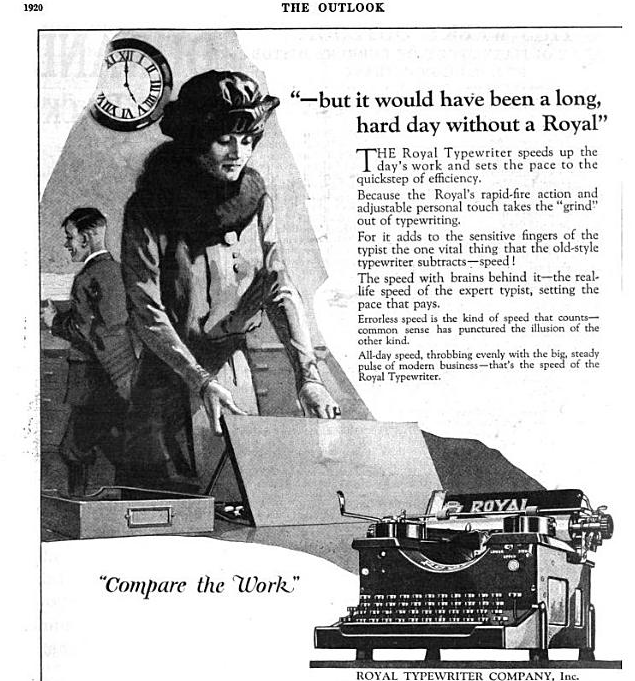
“The speed with brains behind it” –Royal Typewriter Ad, 1920

Screen Shot 2015-08-21 at 9.09.57 AMFrom The Outlook, vol. 126 (1920)

When I was reading through The Outlook the other day, this ad caught my eye. As ad copy, it hits the features as well as the benefits (thank you, Don Draper, for teaching us the difference) but it’s also fascinating for where it positions the women who did the typing.

It’s 5 o’clock. The woman in the picture is between the office boy (I’m guessing, due to his wearing knickerbockers, which a businessman wouldn’t have worn) and the desk where she’s putting down the built-in cover over her typewriter. She’s at the center of things, not the typewriter; although it’s displayed prominently below, it’s not actually shown in the narrative part of the picture, instead being linked by the gray background.

The machine is fast, certainly–the ad mentions “speed” eight times in this short amount of copy–but “the speed that counts” is “errorless speed.”

The typist herself makes this errorless speed happen, with her “sensitive fingers.” She creates “the speed with brains behind it.” It’s her brains and sensitive fingers as she operates the typewriter that create “the big steady pulse of modern business.”

There’s a delicate balance here as the ad elevates her from being just part of the machine of modern business to being a vital part of the brains (and, to judge by “big steady pulse,” its heart) that make the giant beast work.

I’ve been working recently on this rhetoric of connections between women and machines, and this is an ad that constructs the relationship in a sophisticated way. Don Draper would be proud.

“No Irish need apply” a myth? No, it’s true.

nina_may_1_1863

Brooklyn Eagle, May 1, 1863. From Patrick Young’s blog post (link below).

At Easily Distracted, Timothy Burke reports the remarkable story of Rebecca Fried, a high school student at Sidwell Friends, who has disproved Professor Richard Jensen’s contention that “No Irish Need Apply” was a feverish figment of the Irish-American imagination:

Fried’s essay is a refutation of a 2002 article by the historian Richard Jensen that claimed that “No Irish Need Apply” signs were rare to nonexistent in 19th Century America, that Irish-American collective memory of such signs (and the employment discrimination they documented) was largely an invented tradition tied to more recent ideological and intersubjective needs, and that the Know-Nothings were not really nativists who advocated employment (and other) discrimination against Irish (or other) immigrants. existence of signs and ads saying “No Irish need apply,” taken as a given in many history classes, was challenged.

Fried published her findings in “No Irish Need Deny: Evidence for the Historicity
of NINA Restrictions in Advertisements and Signs”, Journal of Social History, 10:1093, 2015.

Patrick Young, who reproduces excerpts from Fried’s article and some of the many supporting ads, also includes some of the back-and-forth between Jensen and a respectful but unintimidated Fried:

Yes there were NINA newspaper ads—I was the one who found the first one—but I argued they were very rare. If a man read every job want-ad in his newspaper every week for 40 years, he would have a 50-50 chance of coming across one NINA ad in his lifetime. That’s what I called very rare—& the student called very common. Richard Jensen

. . .

I also have to respectfully disagree with your numerical calculation. I explain why at page 25 of the article, which is a brief response to your points. Briefly, if the man in your example read the Sun newspaper, he would have read at least 15 male-directed NINA ads in a single year, plus any female-directed ones, plus any from other sources. Thanks again for this. I respect you and your work.
Rebecca Fried

Burke has a nuanced post that discusses the implications for historians, but on an individual (and non-historian) level, I’ll be using this in English 372 this fall not only to illustrate the issue of anti-Irish prejudice, which we discuss in a broader context of racism and xenophobia, but also to highlight the importance of questioning theories and returning to the evidence even when, or especially when, an idea is taken as given.

Bitter Tastes: Which American Women Writers?

 In case you were curious about which “American Women Writers” are in Bitter Tastes, they include the following:

  • Bess Streeter Aldrich
  • Mary Austin
  • Estelle Baker
  • Madeleine Blair
  • Virginia Brooks
  • Willa Cather
  • Kate Chopin
  • Kate Cleary
  • Rebecca Harding Davis
  • Mary Hallock Foote
  • Mary Wilkins Freeman
  • Alice Dunbar-Nelson
  • Sui Sin Far
  • Edna Ferber
  • Zona Gale
  • Ellen Glasgow
  • Emanuel and Anna Marcet Haldeman-Julius
  • Fannie Hurst
  • Edith Summers Kelley
  • Nella Larsen
  • Batterman Lindsay
  • Miriam Michelson
  • Elia Peattie
  • Ann Petry
  • Elizabeth Stuart Phelps
  • Elizabeth Robins
  • Evelyn Scott
  • Gertrude Stein
  • Edith Wharton
  • Lillie Buffum Chace Wyman
  • with side trips to Stephen Crane, Frank Norris, W. D. Howells, Theodore Dreiser, Harold Frederic, and Jack London. (Also, as the title says, silent films.)

A Modest Proposal for MLA 2016: Endorse Skype Interviews

Question: On what issue do ChronicleVitae/Slate blogger and frequent MLA critic Rebecca Schuman and MLA Executive Director Rosemary Feal agree?

Answer: Skype (or videoconference) videos instead of, or at the very least as a valid alternative to, the MLA conference interview.

Schuman reports that some potential candidates had their interview invitations withdrawn when they requested a Skype interview instead.  I can’t speak for all institutions, but that ought to be against the rules.

Should not having $1000 to spend on travel preclude a first-round interview? (And it’s really more like $1500 than $1000, which is a lot of money.) No, it shouldn’t. This is a first-round interview, with campus interviews still to come. The members of the department will still get to meet the second-round candidates as usual.

One angle not yet addressed in various articles about this is the perspective of the search committee.  Maybe some schools send the entire committee, but many more send 1-2 members to do the interviews, partially funding them, with possible assistance from whatever department members are available at MLA.

With a Skype interview, the entire search committee could arrange to be present to interview candidates, thereby giving more members exposure to the candidates and allowing for more input from the entire committee. Those not at MLA wouldn’t have to rely on the reports and notes of those who went, as now happens.

This is the sort of issue that the MLA should put its weight behind, at least to the point of having a discussion or resolution about it in the Delegate Assembly. It may not be as weighty or contentious as some of the issues debated over the past few years, but it will have a direct impact on the organization’s most financially vulnerable members.

A New Yorker goof? WSU doesn’t have MOOCs; it does have online courses

cover_newyorker_80In “Will MOOCs be  Flukes” at The New Yorker, Maria Konnikova reviews research about MOOCs.  Much of it will be familiar to anyone who has read about MOOCs over the past five years, such as the following:

The data suggest, in fact, that the students who succeed in theMOOC environment are those who don’t particularly need MOOCs in the first place: they are the self-motivated, self-directed, and independent individuals who would push to succeed anywhere.

But I was startled to see this:

Even students who succeed in traditional classrooms can get lost in the MOOCshuffle. . . . When Di Xu, an economist at Columbia University’s Teachers College, analyzed data from over forty thousand students who had enrolled in online courses at Washington State University, she found that, relative to face-to-face courses, online students earned lower grades and were less persistent. But not all students fared equally: she found that some subsets struggled more than others. Those subsets were male students, younger students, black students, and students who had lower G.P.A.s. What Xu found, in other words, was that MOOCs were the least effective at serving the students who needed educational resources the most.

To the best of my knowledge, as the English Department’s Vice Chair (hence scheduler) and as a teacher of some online courses, WSU doesn’t offer MOOCs.  “Enrolled in online courses” and “enrolled in MOOCs” are not the same thing, a mistaken conflation of “all online courses are the same”  that many journalists writing on the MOOC phenomenon have made. Even the abstract mentions “online courses” for Xu’s study, not MOOCs.

Although I don’t doubt Xu’s data, which is troubling for what it says about the subsets not being served by online courses, my anecdata from teaching online are a little different.  That’s probably because the courses I teach are much smaller (English 309, Women Writers, is capped at 40; English 402, Technical and Professional Writing and Communication, is capped at 25), and students interact with each other and with me at least twice a week. It’s a hands-on experience. And these courses, which have prerequisites, attract primarily motivated juniors and seniors, so students likely to struggle would probably not be enrolled in them anyway.

While one person’s experience does not a legitimate study make, it does suggest that at least some of what’s being written in the mainstream media about MOOCs needs to be looked at more deeply.

Emoji/Shorthand novels?

Over at Wonders and Marvels, there’s a post up about novels published in shorthand. http://www.wondersandmarvels.com/2014/10/novels-in-shorthand.html

I’m intrigued by this, since there’s been a push lately to write/read/treat as a serious scholarly enterprise novels written in emoji. In fact, this is what some of the cool kids seem to be doing these days in pressing the edge on media studies and digital humanities: http://www.ox.ac.uk/event/ukiyo-e-emoji-museums-digital-age. It seems to me there’s a continuum between this and other forms of electronic production based on symbols.

But since I keep up with future tech but study bygone tech in a bygone age, wouldn’t shorthand novels be just the thing? Couldn’t we treat these as attempts at a digital language and I’ve tried reading some of the novelty 19c. novels written in Morse code, but they were too impenetrable unless you’re fluent in the code.  I can read and write a little shorthand, though (Gregg, not Pittman), and I am wondering about the reading differences among these systems.

Archive or trash?–and who owns it?

At The Atlantic, “The Man Who Made Off with Updike’s Trash” asks, more or less, when is an archive not an archive? When it’s trash?  In this case, a man who on a whim took some of John Updike’s trash years ago continued the practice and now has an archive of discarded pieces. 

Moran has kept thousands of pieces of Updike’s garbage—a trove that he says includes photographs, discarded drafts of stories, canceled checks, White House invitations, Christmas cards, love letters, floppy disks, a Mickey Mouse flip book, and a pair of brown tasseled loafers. It is a collection he calls “the other John Updike archive,” an alternative to the official collection of Updike’s papers maintained by Harvard’s Houghton Library. The phrase doubles as the name of the disjointed blog he writes, and it raises fundamental questions about celebrity, privacy, and who ultimately determines the value and scope of an artist’s legacy.

The blog is at http://johnupdikearchive.com/, and it reproduces all kinds of print materials, including full letters from Updike (with no copyright restrictions? That seems unlikely). 

As the Atlantic article and his biographer Adam Begley points out, Updike was a pretty fair curator of his own legacy, sorting materials and dropping them off at Harvard.

What, then, should scholars make of the alternative archive or trash archive or whatever it should be called?  Should it figure into scholarship on Updike? Does thoroughness demand that scholars working on Updike work from both?


Web pages stolen and uploaded to Scribd: what to do

Update: Scribd fixed the problem within a day, and all is well.

In checking out the new Amazon book service, I recently looked at its competitors, including Scribd. I had looked at Scribd years ago when it seemed to be mostly bad term papers uploaded in impossible formats.  Now it has real books.

When I looked up “naturalism in american literature” to see what criticism might be available, what should pop up but my page at the American Literature/Literary Movements site–but without my name attached.

If you’ve used my site, you know that the Naturalism page is one of the earliest things on the site (1998, give or take), although I’ve updated it. I wrote it and put it on the web for people to use. That’s why it’s there.

Real page:

http://public.wsu.edu/~campbelld/amlit/natural.htm

But stealing the content of the page without attribution and charging people to look at something I intended to be free on the web is really irritating–and also just plain wrong.

Stolen page: http://www.scribd.com/doc/201675150/Naturalism-in-American-Literature

Fortunately, you can report the DMCA violation to Scribd using this form:

http://www.scribd.com/copyright/report-infringement

It took me a little while to find the reporting link, so I’m posting it here in case it will help someone else with the same problem. We’ll see if anything happens once the false page is reported.

Posting academic papers to your own site or academia.edu

I’ve recently posted some older articles to academia.edu and to my own site. This is something for which the copyright issues can still be a little murky.

Elsevier made news last year when it sent takedown notices to scholars who had posted materials on academia.edu. I noticed that several senior scholars in the humanities had posted very recent journal articles to academia.edu, however.

  • Some journals will not permit you to have the articles on your site without the payment of an open access fee, which, when I’ve checked it out, is often $3,000+ for a single article.  That may be fine for the sciences, where grants can be had, but it’s an impossible fee for the humanities.
  • Other journals will permit you to have an older article at your own site but not at academia.edu.
  • Some allow you a “pre-refereed” version but not a version after it has been refereed and set in type. This seems to mean that you can post your manuscript, but since it will not have citable page numbers, your readers will still have to go to the journal site to read and cite your work.
  • Others allow a “pre-print” version set in type.
  • If a journal is published by a press that participates in Digital Commons, as the University of Nebraska Press does, then articles older than the most recent issue are freely available but have to reside at that site.

A useful site in this regard is Sherpa/Romeo at http://www.sherpa.ac.uk/romeo/search.php, which will tell you the policies of the journal. You can also contact the journal editors directly and get permission, of course, which is what I did with the Legacy articles.

It seems to me that anything that gets the word out on a book of essays or an article in a journal, especially if the article was published more than 2 years ago, would be beneficial for the journal or book as well as those who want to cite the work.