
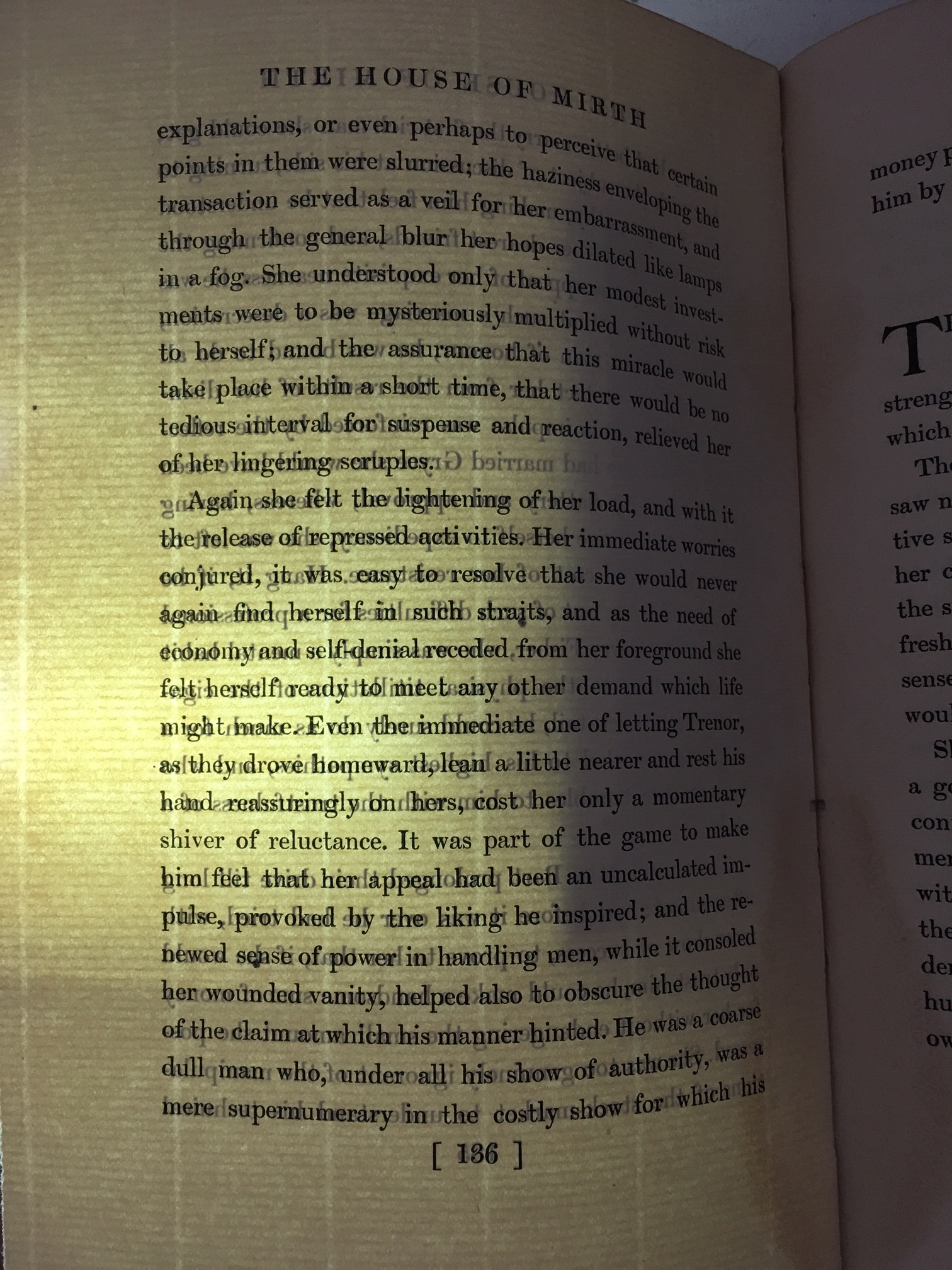
For the edition of The House of Mirth that I’m preparing for the Complete Works of Edith Wharton (OUP), I’ve been collating the Scribner’s Magazine version of with the first American edition, and that means that I’m going line by line, punctuation mark by punctuation mark, through the text. Although this isn’t close reading, the process gives you time to savor every word and react emotionally rather than in a literary critical sort of way.
Here’s one takeaway: most of the men in this book could, to paraphrase Mark Twain writing about Pudd’nhead Wilson and Those Extraordinary Twins, be taken out to the back yard and drowned without any of the women being the worse for it.
[Spoilers ahead if you haven’t read The House of Mirth and content warning for assault.]
Let’s see: there’s Gus Trenor, who essentially tries to rape her; George Dorset, whose self-absorption makes a black hole look navigable; and Selden, the putative hero of the book. What are his sins?
- He is, as generations of scholars have realized, “seldom” there; like Winterbourne in James’s Daisy Miller, he likes to watch the spectacle of a pretty woman rather than take her seriously as a human being.
- He mocks Lily’s initial hunt for a husband, undermining her quest for Percy Gryce (not that Gryce was her soul mate) while giving her no alternative in terms of emotional support or affection.
- He is stirred by the vision of Lily at the tableau vivant, yet he’s willing to believe the worst of her as she escapes from Gus Trenor. In this, he’s not using any logic: why would Lily be Gus’s mistress when it would destroy her chances for a $$$ marriage? She’s not stupid, and yet he lets his conventional ideas and misperceptions read her escape as utterly damning.
- All right, he shows up one time–one time–with an actual plan to help her out, first telling her to leave Bertha Dorset’s yacht and then escorting her to Jack Stepney’s to stay the night. Then–nothing. She’s on her own.
- He tries to get her away from Mrs. Hatch, who employs her, without offering her anything in the way of actual monetary support. Sensing a theme here? He has a lot of ideas about how she can live a “republic of the spirit” life without any of the money that supports it. Thanks a lot, Lawrence.
- Finally, when she visits him for the last time, he has no idea what she’s sacrificed for him. He’s focused on her fragility and physical translucence. He takes hold of her thin hand, tells her “you can never go out of my life,” which she correctly interprets as “see ya,” without any obligation on his part.
- The next day he bounds up the steps to her rooming house like an eager puppy, now that he has “the word which made all clear,” but it’s too late. Question: since he had never bothered to visit her before, in all those months of trial, how does he even know where she lived? Gerty must have told him, and if she did, how damning is it that he knew what dire straits she was in and never bothered to send a note or a word?
Here is the big question:
Why didn’t Selden drop a dime on Bertha Dorset at one of the many opportunities he had when she was persecuting Lily?
Oh, sure, “gentleman’s code” and all that, but he had as much means of blackmail as Lily did–more, even. His reputation wouldn’t suffer.
As Bertha’s former lover, he could have called her and told her to lay off Lily. Or dropped a knowing reference in one of those withering triple-meaning and ironic statements that Wharton’s characters are so fond of using. Or even shot her a knowing glance when she’s ordering Lily off the yacht.
What does our boy Selden do?
Nothing.
On an intellectual level, I know that this is part of Wharton’s point, the tragic consequences of a rigid social order, and all that.
Sure, everyone justly hates Selden on one reading. But part of the brilliance of this book is that there are a thousand tiny points, like the “points of interrogation” about Lily’s character that Rosedale mentions, that allow you to hate Selden fully, madly, deeply.
 It’s no secret that literary critics are shaped by their era, no matter how much the New Critics tried to pretend that they existed in a realm of Universal Truths about Aesthetic Judgment, so I’m not here to pile on to Vernon Louis Parrington’s Main Currents in American Thought (1930).







 Donna M. Campbell
