“No Irish need apply” a myth? No, it’s true.

nina_may_1_1863

Brooklyn Eagle, May 1, 1863. From Patrick Young’s blog post (link below).

At Easily Distracted, Timothy Burke reports the remarkable story of Rebecca Fried, a high school student at Sidwell Friends, who has disproved Professor Richard Jensen’s contention that “No Irish Need Apply” was a feverish figment of the Irish-American imagination:

Fried’s essay is a refutation of a 2002 article by the historian Richard Jensen that claimed that “No Irish Need Apply” signs were rare to nonexistent in 19th Century America, that Irish-American collective memory of such signs (and the employment discrimination they documented) was largely an invented tradition tied to more recent ideological and intersubjective needs, and that the Know-Nothings were not really nativists who advocated employment (and other) discrimination against Irish (or other) immigrants. existence of signs and ads saying “No Irish need apply,” taken as a given in many history classes, was challenged.

Fried published her findings in “No Irish Need Deny: Evidence for the Historicity
of NINA Restrictions in Advertisements and Signs”, Journal of Social History, 10:1093, 2015.

Patrick Young, who reproduces excerpts from Fried’s article and some of the many supporting ads, also includes some of the back-and-forth between Jensen and a respectful but unintimidated Fried:

Yes there were NINA newspaper ads—I was the one who found the first one—but I argued they were very rare. If a man read every job want-ad in his newspaper every week for 40 years, he would have a 50-50 chance of coming across one NINA ad in his lifetime. That’s what I called very rare—& the student called very common. Richard Jensen

. . .

I also have to respectfully disagree with your numerical calculation. I explain why at page 25 of the article, which is a brief response to your points. Briefly, if the man in your example read the Sun newspaper, he would have read at least 15 male-directed NINA ads in a single year, plus any female-directed ones, plus any from other sources. Thanks again for this. I respect you and your work.
Rebecca Fried

Burke has a nuanced post that discusses the implications for historians, but on an individual (and non-historian) level, I’ll be using this in English 372 this fall not only to illustrate the issue of anti-Irish prejudice, which we discuss in a broader context of racism and xenophobia, but also to highlight the importance of questioning theories and returning to the evidence even when, or especially when, an idea is taken as given.

MLA Approaches to Teaching the Works of Jack London available soon

approachesThe new MLA volume Approaches to Teaching the Works of Jack London, edited by Kenneth Brandt and Jeanne Campbell Reesman, should be available soon; Amazon.com lists the publication date as August 1.  http://www.amazon.com/Approaches-Teaching-Works-London-Literature/dp/1603291431

I have an essay on teaching “Samuel” as regional literature in the volume and will update with a full table of contents later.

Workflow for Research Archives

cropped-410px-the_house_of_mirth_page_of_original_manuscript_edith_wharton1.jpgUpdated addition 2/28/23: https://donnamcampbell.wordpress.com/2023/02/28/update-to-workflow-for-research-archives/

Some good recent  posts talk about how to organize your workflow for working in a research archive.

From 2013, Dan Royles on Digital Workflows for the archive at ProfHacker:

http://chronicle.com/blogs/profhacker/digital-workflows-for-the-archives/53505

Jessica Parr at Early Americanists: http://earlyamericanists.com/2015/07/07/making-the-most-of-your-time-in-the-archives-research-technology/?

Both these posts list some good apps as part of the discussion, so check them out.

Since I just returned from a trip to a research archive, here are a few tips, not entirely digital, that I wish I’d thought of earlier.

1. Keep a research log so you know what materials you were working with and when. I used to keep this on a yellow pad (in pencil of course) but have mostly switched to a Word document. It’s in two parts:

One part of the log–the part I still keep on paper–is the list of what boxes I ordered; when I ordered them and the date I ordered them for, since they have to be ordered in advance; and when I returned them. It was just plain easier to see this on a paper pad with returned materials crossed out.

The main part is a running list in a Word document of what I am looking at during the visit: which folders and boxes, generally informal notes about what I’m finding, etc.  Since I had been to this archive before, I was able to look at the log I recorded last time, which saved time when reading the folders.

2. Keep a transcription and notes page for each box as you’re working on it. For some of these, a transcription or notation already existed from the previous visit; I just had to photograph the materials.

This may seem obvious, but when you get home, you may not–in fact, probably won’t–remember whether you looked at Folder 754 and not 755 unless you write it down.  You’ll wonder (or I have), “Did I skip this one, or did it not have anything useful for the project?” Taking a moment to note your impressions will save frustration in the long run. I also wrote down whether I photographed a folder or not.

3. Photograph all the things.  Again, it seems obvious, but it’s a lot faster to photograph items than to read them, especially if you’re short on time.  When in doubt, take a picture.

If you don’t develop a record-keeping system, though, you’ll be lost.

Both Royles and Parr suggest using your phone and TurboScan to record images.  I tried TurboScan but ended up using a camera instead, despite the TurboScan benefits.  Why?

  1. TurboScan was slower than a camera, which may be because I have an older iPhone.
  2. The images weren’t as sharp as I needed (especially for pencil marks).
  3. It would take more time to type in the filenames on the phone’s tiny screen, email the images to myself or upload them to Dropbox, etc., than I wanted to spend.

Using the camera let me take sharp images, which I then downloaded in batches.

4. Organize the photographs to match the archive’s box & folder scheme . After downloading a batch of photos to the Macbook, I moved them immediately from Dropbox’s Camera Uploads folder to Folders named for the box & folder numbers I was working on.  I could then rename the files at leisure, if necessary, which I’ve done some of since I returned from the trip.

Most of them have names like DSCN205-ew to jsmith 25-11-27 pg1.jpg for the first page of a letter from Edith Wharton to John Hugh-Smith written November 25, 1927, for example. Sometimes I make a notation about the work (Ethan Frome, House of Mirth). It’s not searchable, but I can find things in the folders by using the transcription and notes page.

folder example

The collection, box number, and folder number are all right in the picture.

5. Updated to add: put identifying information in the picture. It’s immensely helpful to have the box and folder number right in the image itself.  I used to write these on a piece of paper and then photograph the paper along with the document until I realized (finally!) that if I took a picture with the document top or side near the tab of the folder itself, that information would appear in the picture with no need to write the information on  a piece of paper. If I now lose track of where an image came from, there’s the box and folder number, right in the picture.

I want to keep refining the processes, so there might be an update post in the future. For example, I have premium Evernote, Zotero, iAnnotate, etc. but haven’t used them effectively for archive purposes, as Royles and Parr have done. For now, I’m happy to have the materials and to know that I can find things.

Frank Norris Studies and the Dreiser Newsletter now available online

Some years back, for the Howells Society site and the Frank Norris page, I compiled a list of Frank Norris Studies even though it was unfortunately not available.

Now it is!

Here’s the link to the complete run of Frank Norris Studies:

http://franknorrissociety.org/frank-norris-studies-1986-2004/

And here’s the link to the Dreiser Newsletter.There’s also an index.

http://www.dreisersociety.org/the-dreiser-newsletter.html

I will be the Frank Norris and Theodore Dreiser pages to reflect two good new resources,

Edith Wharton’s Favorite Novels (and The House of Mirth isn’t among them)

From an interview, supposedly Edith Wharton’s first.

Carroll, Loren. “Edith Wharton in Profile. In first interview of Long Career, America’s Famed Novelist Talks of Growing Interest in Theatre.” New York Herald. Paris Edition. Nov. 16, 1936, page 6, column 6. [Date corrected 7/4/23. Thanks to Robin Peel and to Stewart Gillies at the British Library for the correct citation.]

. . .

But many “radical” novelists, she thinks, are only deceiving themselves. “Their preoccupation with new methods and details of technique is simply a sign of fatigue. The English language is not dead; it is inevitably enlarging itself. Dropping out capital letters and punctuation is only a symptom of poverty of imagination. The main thing is still creation of character, just as it was for Tolstoy, Stendahl, Trollope, Thackeray, George Eiot, Flaubert, and Henry James.”

These names were not produced at random. From their work Mrs. Wharton makes her choice of great novels: “War and Peace,” “La Chartreuse de Parme,” “The Portrait of a Lady,” “Middlemarch,” Trollope’s political novels and “several of Thackeray’s.” Of “The Portrait of a Lady, she says, “It is a perfect thing of its kind.” And of George Eliot, “If she hadn’t gone to live with George Henry Lewes, and felt obliged in consequence to defend conventional morality, she might have been one of the greatest of English novelists.”

Disclaiming any intention of estimating her own work, Mrs. Wharton is willing, nevertheless, to choose her own favorites. They are “The Custom of the Country,” “Summer,” “The Children,” “Hudson River Bracketed” and “The Gods Arrive.”

. . . .

Amlit updates: Experimental Harriet Beecher Stowe bibliography

I’ll be updating the American lit site over the next few months, including the bibliographies. Since what I generally want to find is what’s new on an author, the Harriet Beecher Stowe bibliography is arranged by the newest material first. http://public.wsu.edu/~campbelld/amlit/stowebib1.htm

It seems to me that since the combination of web and wordprocessing software provides multiple ways of changing and ordering texts, this would be a more efficient solution than putting the little “New” tag in as I have done in the past.

This is an experiment; the older bibliographies will be updated in the conventional way.

Let me know in the comments or by email (campbelld@wsu.edu) if you have any thoughts/preferences.

Jack London on the modern university

jacklondonJack London took a lot of potshots at universities and university professors; in Martin Eden, for example, or in “South of the Slot,” where a professor vanishes into the life of a labor organizer. The portrayals are usually highly unflattering.

But in The Iron Heel, a professor loses his job because of his radical associations, but not before the president of the university tries to get him to leave quietly:

“He [the president] said that the university needed ever so much more money this year than the state was willing to furnish; and that it must come from wealthy personages who could not be offended by the swerving of the university from its high ideal of the passionless pursuit of passionless intelligence.  When I tried to pin him down to what my home life had to do with swerving the university from its high ideal, he offered me a two years’ vacation, on full pay, in Europe, for recreation and research.  Of course I couldn’t accept it under the circumstances. . . . It was a bribe.”

The Iron Heel was published in 1908, and professors don’t get offered vacation on full pay any more, if they ever did, but London had some insight into how the university works.

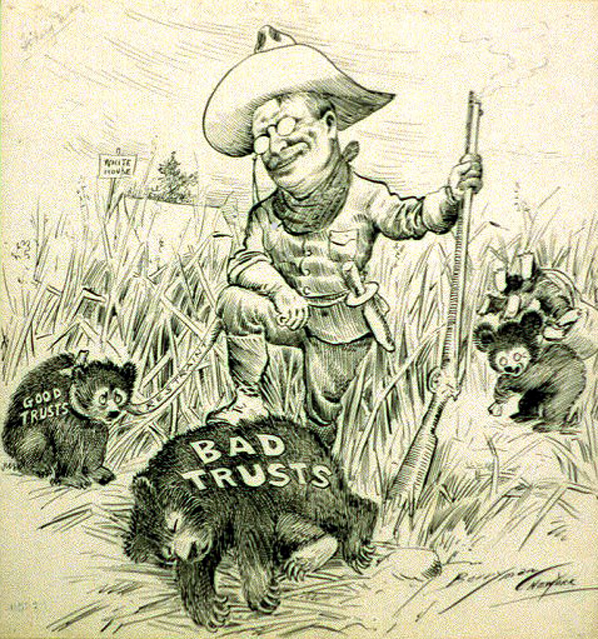
Teddy Roosevelt Humor from Mr. Dooley (Finley Peter Dunne) in The Bully Pulpit

roosevelt_huntI’m rereading (print copy) and relistening to Doris Kearns Goodwin’s The Bully Pulpit: Theodore Roosevelt, William Howard Taft, and the Golden Age of Journalism, the audio version read by the incomparable (and, sadly, late) Edward Herrmann.

This part made me laugh out loud:

Roosevelt’s ability to countenance criticism in the interest of friendship also marked his relationship with the humorist Finley Peter Dunne.  Dunne’s weekly columns in the Chicago Times-Herald, featuring his adopted persona, the irreverent Irish bartender Martin Dooley, placed him among the nation’s most popular and influential literary figures.  Dunne later recalled that his “first acquaintance with Col. Roosevelt grew, strangely enough, out of an article that was by no means friendly to him.”

In the fall of 1899, a copy of The Rough Riders, Roosevelt’s wartime memoir, came across Dunne’s desk. “Mr. Dooley’s” book review in Harper’s Weekly mocked Roosevelt’s propensity for placing himself at the center of all the action: “Tis Th’ Biography iv a Hero be Wan who Knows. Tis Th’Darin’ Exploits iv a Brave Man be an Actual Eye Witness,” Mr. Dooley observes.  “If I was him, I’d call th’ book, ‘Alone in Cubia.”

[Roosevelt apparently loved this joke at his expense.]

“I never knew a man with a keener humor or one who could take a joke on himself with better grace,” Dunne recalled.  For years, Roosevelt told and retold the story of meeting a charming young lady at a reception: “Oh, Governor,” she said, “I’ve read everything you ever wrote.”

“Really! What book did you like best?”

“Why, that one, you know, Alone in Cuba.” 

(pp. 257-58; additional paragraphing added to facilitate web reading).

New Frank Norris Society Site and American Literary Naturalism Newsletter Archive

cropped-norris-bannerUpdate 2/28/23: Site is no longer active.

The Frank Norris Society has a beautiful new site at http://franknorrissociety.org/, courtesy of Eric Carl Link, Steven Frye, and Hannah Huber.  There you can find a membership form and also the back issues of The American Literary Naturalism Newsletter, which is indexed by the MLA.   

Congratulations to the FNS for putting together this resource!

Bitter Tastes: Which American Women Writers?

 In case you were curious about which “American Women Writers” are in Bitter Tastes, they include the following:

  • Bess Streeter Aldrich
  • Mary Austin
  • Estelle Baker
  • Madeleine Blair
  • Virginia Brooks
  • Willa Cather
  • Kate Chopin
  • Kate Cleary
  • Rebecca Harding Davis
  • Mary Hallock Foote
  • Mary Wilkins Freeman
  • Alice Dunbar-Nelson
  • Sui Sin Far
  • Edna Ferber
  • Zona Gale
  • Ellen Glasgow
  • Emanuel and Anna Marcet Haldeman-Julius
  • Fannie Hurst
  • Edith Summers Kelley
  • Nella Larsen
  • Batterman Lindsay
  • Miriam Michelson
  • Elia Peattie
  • Ann Petry
  • Elizabeth Stuart Phelps
  • Elizabeth Robins
  • Evelyn Scott
  • Gertrude Stein
  • Edith Wharton
  • Lillie Buffum Chace Wyman
  • with side trips to Stephen Crane, Frank Norris, W. D. Howells, Theodore Dreiser, Harold Frederic, and Jack London. (Also, as the title says, silent films.)