#mla2014 Session 601: Naturalism and Poverty: New Perspectives in Comparative Context

One of the sessions related to the Presidential Theme, Vulnerable Times

601. Naturalism and Poverty: New Perspectives in Comparative Context
Saturday, 11 January3:30–4:45 p.m., Mississippi, Sheraton Chicago

A special session
Presiding: Eleni Eva Coundouriotis, Univ. of Connecticut, Storrs

1. “No Money, No Money, No Money: Renaturalizing Jean Rhys,” Andrea P. Zemgulys, Univ. of Michigan, Ann Arbor

2. “Wasted Bodies: Poverty, Disability, and Cinematic Naturalism in Wharton, Crane, and Early Film,” Donna M. Campbell, Washington State Univ., Pullman

3. “The Adulterous Geopolitical Aesthetic: Naturalism and the Literary Channel before Zola,”Lauren M. E. Goodlad, Univ. of Illinois, Urbana

Howells in the News: W. D. Howells, Steampunk Spymaster at Wired

Reposted from the Howells Society site: Howells in the News: W. D. Howells, Steampunk Spymaster at Wired

At Wired, Bruce Sterling reads Howells’s “American Literature in Exile.”  A sample:

*It’s good to read Howell because he’s so secure in his own world. He’s properly dressed in his own Manhattan tie-and-tails; he’s not bitterly agitated, or preyed upon by bipolarity, like Clemens was. Howells is energetic without ever being antic. He gives the impression of a natural ruling-class figure who would likely do very well in the State Department.

*There’s a steampunk version of the Howells-Twain relationship where Howells is “M,” the master spy, the firm-hand-on-the-tiller, while Mark Twain is his brilliant yet reckless field agent, with a license to wander the world and kill off steampunk super-villains. I shouldn’t have said that, because now somebody’s gonna do it and get it all wrong; but, well, I’m in literary mode now, writing an Italian dieselpunk story, and the flights of fancy are proliferating out of control.

Library of Congress Silent Film Database

The Great Gatsby

Herbert Brenon’s The Great Gatsby is a lost film, but the trailer still exists. Image courtesy of http://bookdirtblog.blogspot.com/2013/09/the-lost-great-gatsby-film-of-1926-only.html

A few weeks ago, a new study reported that 75% of all silent films are lost. I’d often heard 80-90% as the figure, so while still a “staggering loss,” at least there’s now a comprehensive look at what is missing and what is extant.

From the Library of Congress:

The Library of Congress today unveiled “The Survival of American Silent Feature Films: 1912-1929,” the first comprehensive survey of American feature films that survived the silent era of motion pictures. Previous documentation established that nearly 11,000 (10,919) silent feature films of American origin were released from 1912 through 1929. There was, however, no definitive, systematic study on how many of these films still existed and where any surviving elements were located in the world’s leading film archives and private collections.

The groundbreaking study reveals some startling facts about America’s endangered silent-film heritage. Only 14 percent—about 1,575 titles—of the feature films produced and distributed domestically from 1912-1929 exist in their original format. Five percent of those that survived in their original 35 mm format are incomplete. Eleven percent of the films that are complete only exist as foreign versions or in lower-quality formats.

“The Library of Congress can now authoritatively report that the loss of American silent-era feature films constitutes an alarming and irretrievable loss to our nation’s cultural record,” said Librarian of Congress James H. Billington. “We have lost most of the creative record from the era that brought American movies to the pinnacle of world cinematic achievement in the 20th century.”

“This report is invaluable because the artistry of silent film is essential to our culture,” said Martin Scorsese, film-preservation advocate and director of “Hugo,” a loving tribute to silent film. “Any time a silent picture by some miracle turns up, it reminds us of the treasures we’ve already lost. It also gives us hope that others may be discovered. The research presented in this report serves as a road map to finding silent films we once thought were gone forever and encourages creative partnerships between archives and the film industry to save silent cinema.” [more available at the link]

The new database is available at

http://lcweb2.loc.gov/diglib/ihas/html/silentfilms/silentfilms-home.html

Side note: WSU site is still down.

Dorothy Parker a plagiarist? Say it isn’t so!

A recent article on Vulture.com makes a case for a little “creative borrowing,” otherwise known as plagiarism, on Dorothy Parker’s part as an attempt to revive her fading career.  It argues that Parker saw Nabokov’s Lolita well before she reviewed it (favorably) for Esquire, when it was being handed around in literary circles by a careless Edmund Wilson, and that she borrowed the title for her short story “Lolita”:

Had this, in fact, been her second look at the book? The trail, it seems, leads to Edmund Wilson. In 1954 and 1955, Parker was a regular guest at his gatherings at the Algonquin when he was in New York, though his other friends objected to her habit of coming “an hour late” and offering odd excuses, like having to walk her sister’s dog. She is more than likely to have visited him in Talcottville as well, where Wilson had been indiscreet with the manuscript. He would have been very likely to also impress on her his major points about Lolita: that the novel was “repulsive,” that it would never be published in the United States, and that Nabokov was vehement about people not knowing that he was the author. Uninspired, a little desperate, and nearly broke, Parker may have been susceptible to an intriguing prompt. Being Dorothy Parker, she also probably could not resist the opportunity to sting the current “golden boy” of The New Yorker by letting him know that she was aware of his secret.

I had read once that Nabokov got the name from Lillita McMurray, the 16-year-old bride of Charlie Chaplin back in the mid-1920s, who was expensively divorced from him a few years later.

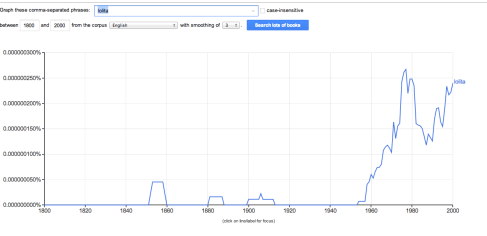
But Nabokov did not need to go that far to get the name, nor did he invent it, as Google’s handy ngram viewer shows:
Image

“Lolita” is used as a name as early as 1851, although it clearly takes a huge leap once Nabokov’s book comes out. Among others, it appeared in a Bret Harte story of 1899, Charles Lummis’s Out West magazine in 1907, and as the protagonist’s name in Owen Wister’s “La Tinaga Bonita” in Harper’s  in 1895.

But those are old usages, you say? How about Bill Johnson’s Ghost Road (1950) or, yes, a Nancy Drew mystery, Carolyn Keene’s 1954 The Ringmaster’s Secret? 

Nabokov may have reinvented the name, and Parker may have borrowed it, but the story doesn’t show any parallels.  Yes, as the article says, there’s a drive in a car, not exactly uncommon in American literature.  But I had always read Parker’s story as being about a theme she’d discussed with Robert Benchley back in the 1920s: what if a man left his beautiful, fascinating wife to take up with a mousy, ordinary mistress?

Parker’s “Lolita” is a story on a familiar theme in her works: the frustratingly obtuse and domineering person (often a mother), who can’t understand why people respond to her the way that they do.  In the story, which is narrated from a third person limited omniscient point of view, Mrs. Ewing, Lolita’s mother, is another familiar Parker character, the flirtatious and feminine Southern(ish) belle who can’t understand what the handsome John Marble sees in her daughter.

There’s more than a hint of sexual competition with her daughter in Mrs. Ewing’s every move: why isn’t he paying attention to her? She undercuts her daughter at every turn, destroying their evenings together as she natters on about nothing and believing that Ewing will eventually leave Lolita: “I say, ‘That’s right, honey, you go ahead and be happy just as long as you can'” (391). As she says to a friend at the end of the story, ”

“A man like John Marble married to a girl like Lolita! But she knows she can always come back here. This house is her home. She can always come back to her mother.”

For Mrs. Ewing was not a woman who easily abandoned hope.

So far, this doesn’t bear much resemblance to Lolita, but it bears a great deal of resemblance to other Parker stories where deluded (and horrible) women wait in hope to destroy someone they are supposed to love. Exhibit A for this would be “The Banquet of Crow” (Esquire, 1957–another late story), but there are others, too.

So did Parker borrow the name from Nabokov?  Maybe.  Judging by the 1950s uses, it might have been one of those names that crops up in cycles, like Jason and Jennifer or Owen and Emily.

Would she have done it to get a little extra publicity, knowing that Nabokov’s book might be published or at the very least that the name would garner a little attention from literary circles? Probably.

Is there a hint of Nabokov’s tale in the story of a harridan mother competing with her daughter for the same man, only to lose out to the daughter’s superior if inexplicable charms? Uncomfortably, yes.

But did she steal the plot from Nabokov, and is this character  an anomaly in the Parker canon? Absolutely not.

[Edited to add: Would Parker really have gone to Talcottville, which is a very small town on SR 12D near Boonville, NY? (I have a picture somewhere of me standing in front of Edmund Wilson’s Talcottville home, the “stone house” that he wrote about, that’s an ineradicable record of my literary geekitude.) Parker, of whom it might be said, “There is no city but New York, and Parker is its prophet”?]

Biography Corner: Review of Stephen Crane Remembered

SORRENTINO, PAUL, ED. Stephen Crane Remembered. University of Alabama Press, 2006. 400 pp. $57.50.

In 1895, Willa Cather, then a college student, was working for the Nebraska State Journal when she met a thin, shabbily dressed young man who introduced himself as Stephen Crane. At that time Crane was one of her literary heroes, so she cut classes to stay in the State Journal office and “trap him in serious conversation.” Cather was rewarded one evening when Crane let his guard down and described his writing process, in which “the detail of a thing has to filter through my blood” before he could write about it.  When she “suggested to Crane that in ten years he would probably laugh” at his discomfort in writing, he responded, “I can’t wait ten years. I haven’t time” (177). But is Cather’s account true, or did she fictionalize it later to present her own version of Crane as a romantic artist with a tragic premonition of his own early death? Incidents such as these, and the questions they raise, are at the heart of Paul Sorrentino’s excellent Stephen Crane Remembered, a collection of reminiscences by Crane’s contemporaries. Divided geographically and chronologically into seven sections, from Crane’s childhood in Port Jervis through his college years, his time in New York, his travels in the West, Florida, and Cuba, and his final years in England, Stephen Crane Remembered creates a composite portrait of this enigmatic author.

Stephen Crane Remembered presents Cather’s account along with those of sixty-one others who knew Crane, including Joseph Conrad, H. G. Wells, Ford Madox Ford, Richard Harding Davis, and Hamlin Garland, as well as reminiscences by those known primarily through their relationship to Crane, accounts previously available only in archives or out-of-print publications.  Among these are recollections from his nieces, his classmates, the artists with whom he shared a creatively rich but materially impoverished life in New York, his fellow correspondents in Cuba during the Spanish-American War, and some of the many visitors that crowded Brede Place as Crane desperately tried to write enough fiction to support his household there.  As Sorrentino states in his introduction, several of the writers were influenced by Thomas Beer’s Stephen Crane (1924), a fictionalized biography accepted as fact by most Crane biographers  before Sorrentino and Stanley Wertheim exposed Beer’s fabrications in The Correspondence of Stephen Crane (1988).

Although all the selections are presented with few in-text emendations so as not to disrupt the authors’ narratives, Sorrentino provides an informative biographical introduction for each and supplements these with extensive and well-researched footnotes, thus ensuring that neither Beer’s falsehoods nor other misstatements by the authors stand uncorrected. For example, citing Bernice Slote, Sorrentino notes that Cather’s account is incorrect in some details and that Cather echoes later assessments of Crane, suggesting that she had dramatized her encounter with him. Comprising one-sixth of the book, the footnotes are also an unusually rich source of details about Crane’s life, for in them Sorrentino provides not only publication details but other information, such as one fraternity brother’s recollection that the manuscript of Maggie: A Girl of the Streets was “saturated with obscenity and profanity” (316 n.32) or another’s story that a lost manuscript by Crane is hidden in the walls of the fraternity house. The notes also resolve conflicts over the composition and publication history of works such as Maggie:  Crane’s niece Helen R. Crane believes that it was written in “two or three nights” at the home of her father, Crane’s brother Wilbur Crane (47); a classmate, Abram Lincoln Travis, thought Crane had written it in boarding school (62); Frank W. Noxon, a fraternity brother, believed that it was written while Crane was at Syracuse in 1891 (73); and two others place its composition in New York in 1892. In assessing these accounts, confirming some and dismissing others, Sorrentino concludes that Crane was “working on his first novel while at Syracuse” (317 n. 32).

The portrait of Crane that emerges from these overlapping slices of biography includes fresh retellings of familiar incidents from Crane’s life. For example, accounts of Crane’s courage under fire during the Spanish-American War appear in two different versions of the battle of San Juan Hill in Cuba on July 1, 1898. In Cecil Carnes’s account, Crane, wearing a white raincoat that makes him an excellent target, stands gazing at the Spanish lines despite a direct order from the newly promoted General Leonard Wood to get down and stop exposing himself to fire. James H. Hare, a photographer, forces him to lie down by saying, “What’s the idea, Steve? Did you get a wire from Pulitzer this morning reading: ‘Why the hell don’t you get wounded so we can get some notices, too?” (224). Reporting on the same incident, Richard Harding Davis recalled, “I knew that to Crane, anything that savored of a pose was hateful, so, as I did not want to see him killed, I called, ‘You’re not impressing any one by doing that, Crane.’ As I hoped he would, he instantly dropped to his knees” (347 n. 37). Despite their differences, both accounts emphasize not just Crane’s indifference to danger and his determination to get the story but also his dislike of ostentatious displays of courage. Another memorable image that confirms Crane’s hatred of display is Charles Michelson’s description of  Davis, resplendent in a tailored uniform “striated with service ribbons,” singing “Mandalay” and accompanying himself on the banjo before an admiring crowd as the “tongue-tied” Crane sat in the shadows “in his old campaign clothes” and refused to discuss his work in such a company (219).

Equally interesting are the accounts of influences on Crane’s writing: Sorrentino notes that those who claim that Crane read the French or Russian realists rely largely on Beer’s biography, but Crane’s sense of gratitude toward William Dean Howells and Hamlin Garland, who despite their limitations had promoted his career and “blazed the way” (279) for contemporary literature, occurs in at least one authentic reminiscence. A common thread in the reminiscences is that of the author at work on his writing: Crane assuring Hamlin Garland that “little rows” (94) of the poems that would become The Black Riders were complete in his mind before he wrote them down, or shutting himself up in the “red study” (277) at Brede Place each morning to write before greeting his guests, pausing only to let in his beloved dogs, or, as several writers recall, Crane bent over a sheet of paper, spending a long time carefully searching for the right word before slowly writing down the sentences he had formed in his head.

Stephen Crane Remembered is selective rather than comprehensive; reminiscences readily available elsewhere, such as Corwin Knapp Linson’s My Stephen Crane, reviews by William Dean Howells, and Elbert Hubbard’s obituary of Crane, are omitted, as are pieces already included in Wertheim and Sorrentino’s The Crane Log: A Documentary Life of Stephen Crane, 1871-1900 (1994) and The Correspondence of Stephen Crane, which Stephen Crane Remembered complements rather than supersedes. The Correspondence presents Crane in his own words, but Stephen Crane Remembered fills in the other side of the story, providing not only fresh and interesting glimpses of Crane as a writer and a human being but a superb biographical context, in the form of the introductions and notes, for assessing and understanding the stories told by Crane’s contemporaries.

New Stephen Crane Society Site

The Stephen Crane Society site has been moved to http://stephencranesociety.wordpress.com, and it now has a Twitter feed, @StephenCraneSoc. This will make searching the site’s content easier and will also help with disseminating information about updates, calls for papers, news about Crane, and so on.

As with the Howells and Wharton Society sites, some of the texts remain on university servers, but most of the content has moved, including the Queries.

If you haven’t checked out the Queries, the contents may surprise you. From 2000-2010, noted Crane scholar Stanley Wertheim answered many of the questions, and there is a wealth of information in those questions and answers. Stephen Crane

A hardwired fear of snakes reported–in 1896. Harold Frederic’s The Damnation of Theron Ware

The Los Angeles Times and other news outlets report that the brains of Japanese macaques (and possibly human beings) may be hard-wired to fear snakes

The results, published online Monday in the journalProceedings of the National Academy of Sciences, appear to support a theory that early primates developed advanced perception as an evolutionary response to being prey, not as an adaptation that may have made foraging or hunting easier.

Though fear of snakes may not be innate, noticing them more than other phenomena may be hard-wired by evolution, said Lynne Isbell, an evolutionary biologist fromUC Davis and one of the authors of the paper. That heightened attention, research has shown, can lead to early and resilient learned behavior, such as fear-mediated avoidance. In other words, getting out of the way of snakes. [. . . ]

The researchers used two monkeys raised in captivity that had no opportunity to encounter a snake. Probes measured responses to snakes, faces and hands of monkeys, and geometric shapes. More neurons responded to the snakes, and did so with greater strength and speed, the data showed.

This passage from Harold Frederic’s 1896 novel The Damnation of Theron Ware anticipates these results.  In the following passage, Dr. Ledsmar, an evolutionary scientist, is leading the naive minister Theron Ware around various scientific exhibits in his house.

They moved out of the room, and through a passage, Ledsmar talking as he led the way. “I took up that subject, when I was at college, by a curious chance. I kept a young monkey in my rooms, which had been born in captivity. I brought home from a beer hall—it was in Germany—some pretzels one night, and tossed one toward the monkey. He jumped toward it, then screamed and ran back shuddering with fright. I couldn’t understand it at first. Then I saw that the curled pretzel, lying there on the floor, was very like a little coiled-up snake. The monkey had never seen a snake, but it was in his blood to be afraid of one. That incident changed my whole life for me. Up to that evening, I had intended to be a lawyer.”