 Booth Tarkington’s The Magnificent Ambersons is a book I used to read and reread years ago, so much so that when I heard there was a movie with Orson Welles, I assumed immediately that he was perfect casting for George Minafer. I didn’t know at the time that it was a brilliant film by Welles much altered in the editing room, or that Tim Holt played the part. Holt was good, but I still think that the young Welles could and should have played it.
Put rather too simplistically, it’s the story of a declining family, the Ambersons, in a gradually industrializing town that’s passing them by. The protagonist is George Amberson Minafer, as insufferable a character as you’ll ever meet in fiction: proud, pig-headed, wielding class privilege like a whip–sometimes literally. His adoring mother, Isabel, had married George’s father, Wilbur Minafer, out of pique when her suitor, Eugene, showed up drunk one night and serenaded her. Isabel spoils George outrageously, as the town predicts she will.
When Eugene, now a widower, and his daughter, Lucy, return to their “Midland town,” Eugene falls in love with the now-widowed Isabel, and George courts Lucy, who loves him but is exasperated by his behavior. George forbids Isabel (his mother, remember) to see Eugene, and she dies without having had a chance to say goodbye to him.
On one occasion, Lucy tries to explain to Eugene, by using a supposedly Native American legend, why she’s so attracted to George, even though he’s a character that the reader mostly wants to strangle:
“Vendonah [Rides-Down-Everything] was an unspeakable case,” Lucy continued. “He was so proud that he wore iron shoes and he walked over people’s faces with them. He was always killing people that way, and so at last the tribe decided that it wasn’t a good enough excuse for him that he was young and inexperienced—he’d have to go. They took him down to the river, and put him in a canoe, and pushed him out from shore; and then they ran along the bank and wouldn’t let him land, until at last the current carried the canoe out into the middle, and then on down to the ocean, and he never got back. They didn’t want him back, of course, and if he’d been able to manage it, they’d have put him in another canoe and shoved him out into the river again. But still, they didn’t elect another chief in his place. Other tribes thought that was curious, and wondered about it a lot, but finally they came to the conclusion that the beech grove people were afraid a new chief might turn out to be a bad Indian, too, and wear iron shoes like Vendonah. But they were wrong, because the real reason was that the tribe had led such an exciting life under Vendonah that they couldn’t settle down to anything tamer. He was awful, but he always kept things happening—terrible things, of course. They hated him, but they weren’t able to discover any other warrior that they wanted to make chief in his place. I suppose it was a little like drinking a glass of too strong wine and then trying to take the taste out of your mouth with barley water. They couldn’t help feeling that way.”
George eventually gets his come-uppance, as everyone in the town hopes he will, but virtually no one is there to see, or care, or remember the Ambersons.
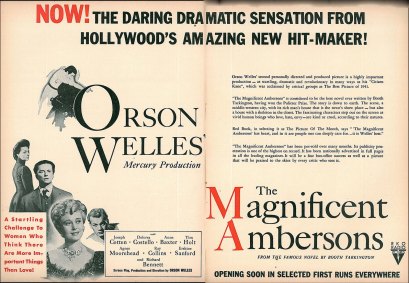 One of the things that Tarkington gets a lot right in the psychology of a small town is this idea of the figure that a town–or a media cycle in an election year, come to think of it– love to hate but can’t resist talking or writing about. The town doesn’t love George, or even like him, but as he does for Lucy, he makes life exciting for the town. There’s a sizable shelf of critical books on why protagonists don’t have to be likable (hello, Modernism!), but Tarkington hits on one idea–excitement–that’s often missing from these accounts.
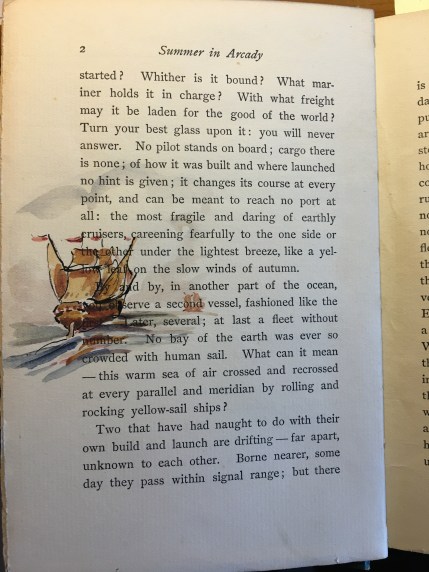
 Today I’ve been rereading James Lane Allen’s Summer in Arcady: A Tale of Nature (New York: Macmillan and Co., London: Macmillan & Co., Ltd., 1896) and noticed something that I hadn’t remembered, something not covered in the yellow Post-Its that mark the content–marginalia.

 Starting to work on proofreading for Bitter Tastes: Literary Naturalism and Early Film in American Women’s Writing, forthcoming from University of Georgia Press in September.
 In this month’s Valley of the Moon Magazine, Jonah Raskin says, well, maybe he did.
 What struck me about the book, even in this truncated form, isn’t the gossip but its its account of Hughes’s process of poetic creation. I knew something about this (Graves’s The White Goddess, etc.) from a grad class in which we read “The Jaguar” and Crow, but it’s not until the later chapters that Bate speaks powerfully to this. Bate clearly sees Lupercal and to a lesser extent Crow as the highlight of Hughes’s career, with occasional descents after that into vatic self-importance amid some genuinely good poems and a host of public performances (as Poet Laureate and public intellectual) that diluted his gifts.
 Bate shows Hughes as constantly on the edge of a more confessional mode–in the early 1970s, for example–but held back by these fears. It’s as though Hughes teeters on the confessional versus vatic/safe imagistic poems precipice and goes with safety but then unleashes his powers in The Birthday Letters. The Birthday Letters frees him, but Hughes expresses the thought that it may be 30 years too late for the electric voltage of the early poet of “The Thought Fox” and “The Jaguar.”
 Donna M. Campbell