Encyclopedia of American Studies Goes Open Access

This notice sent to ASA members announces a welcome new open access resource: 

Encyclopedia of American Studies Goes Open Access

by Monique Laney

In an effort to provide researchers with an alternative source of information, the Encyclopedia of American Studies (EAS) has adopted an open access policy. Scholars and others studying American culture and society can now search the extensive database athttp://eas-ref.press.jhu.edu free of charge. “The field of American Studies has changed a great deal since the print version of the encyclopedia was first released in 2001,” said EAS editor Simon Bronner. “We heard from scholars and institutions globally about access and realized we had the opportunity with a new format to keep up with the latest developments.”

The EAS is sponsored by the American Studies Association and hosted by the Johns Hopkins University Press, publisher of the ASA’s official journal American Quarterly. The online version first appeared in 2003. The encyclopedia home page received a new look to coincide with the switch to open access. Bronner explained some of these changes in a recent podcasthttp://www.press.jhu.edu/journals/podcasts.html. The Encyclopedia has more than 800 online, searchable articles and accompanying bibliographies, related websites, illustrations, and supplemental material covering the history, philosophy, arts, and cultures of the United States in relation to the world, from pre-colonial days to the present.

“We wanted to show the institutional value of American studies as an interdisciplinary perspective which may not exist in other online resources,” said Bronner, chair of the American Studies Program and distinguished professor of American studies and folklore at Pennsylvania State University, Harrisburg. “The Encyclopedia includes interpretive angles that show trends and ideas of research that may provoke a different line of thinking.” Bronner said that the editorial board of the Encyclopedia, which includes scholars from the U.S., Hong Kong and Switzerland, will work to continually update the site. He also said plans exist to expand the amount of multimedia content available to users of the Encyclopedia.
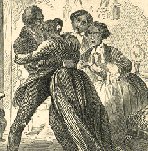
Annette Gordon-Reed on Solomon Northup’s 12 Years a Slave

ImageIn The New Yorker this week, Annette Gordon-Reed discusses Northup’s 12 Years a Slave (available here) and the issues of the genre of slave narratives:

As powerful as they are, slave narratives are often said to raise special concerns as items of historical evidence. One argument goes as follows: White abolitionists, who almost always had a hand in helping to prepare and disseminate the narratives, hoped to destroy slavery by highlighting the more shocking aspects of the institution—the whippings, the separations of families, and the sexual abuse of enslaved women. As a result, the argument continues, the narratives adhere to a literary convention in which all of these events must play a prominent role, raising questions about the veracity of the stories. This seems a rather odd complaint, given that we know from other sources that whippings, separation of families, and sexual abuse were endemic to the institution. It would be more incredible, quite frankly, if Solomon Northup had spent twelve years on a slave plantation in Louisiana without encountering all of these things.

Another concern centers on the nature of the relationship between white sponsors and black narrators. Given the racial power dynamics, could blacks speak freely to the abolitionists and, later, to the white interlocutors who gathered stories for the Work Project Administration (W.P.A.), during the nineteen-thirties? If points of conflict arose, whose view would prevail? It has also been noted that the W.P.A. interviewees were children during slavery. A number of them painted almost benign pictures of the institution of slavery. Was this done to please their white interviewers, who were, after all, agents of the government, or were they just remembering a world through the eyes of children, without the heavy burdens that their parents had known?

There are other issues with slave narratives, but the simple fact is that every form of historical evidence has its own set of problems.

Gordon-Reed’s magisterial book on Thomas Jefferson and Sally Hemings, which she references in the concluding paragraphs, sorts out these issues in great detail, distinguishing between what we can and cannot know about the relationship between the two and what the documentary evidence can and cannot reveal.

Trove of Emily Dickinson Documents

Update:  Julie Dobrow on Lithub (2018) provides additional information but says that the typewriter was a borrowed Hammond typewriter.

Update: More on Dickinson and the Amherst/Harvard controversy at The New York Times: 

http://www.nytimes.com/2013/10/23/books/enigmatic-dickinson-revealed-online.html?pagewanted=1&ref=books

And here is the Amherst archive link: https://www.amherst.edu/library/archives/holdings/edickinson

The Boston Globe (http://www.bostonglobe.com/metro/2013/10/19/trove-emily-dickinson-manuscripts-appear-online/5NWTLLg5qM8WjF0Hjb8LzH/story.html) reports that Amherst and Harvard are rolling out an online collection of Dickinson materials this week but that there’s friction between the two institutions dating back to the Todd/Dickinson controversies that emerged after Dickinson’s death.

As anyone who’s read Lyndall Gordon’s Lives Like Loaded Guns or other books on Dickinson can attest, it’s a vexed and interesting history–unless you’re involved in it, of course, in which case it’s just vexed.

One of the things that Gordon explains, almost as an aside, is that in transcribing Dickinson’s poems after her death, Mabel Loomis Todd first used what was known as an index typewriter, the World typewriter,  that required the user to point at a letter and press a key to stamp it into the page. To say that this must have been slow going is an understatement.

From the article:

The conflict echoes the longstanding dispute between Harvard and Amherst over who may lay more rightful claim to Emily Dickinson. When Dickinson died, her sister, Lavinia, discovered hundreds of her poems.

Lavinia approached their sister-in-law, Susan Dickinson, about editing the poems. Susan Dickinson delayed too long, and Lavinia turned to Mabel Loomis Todd, wife of an Amherst professor and Emily Dickinson’s brother’s mistress.

Todd enlisted the help of Thomas Wentworth Higginson and the two edited the poems — changing punctuation, amending the text, and adding titles. They published three volumes of Dickinson’s work, the last in 1896. Two years later, a dispute arose between Todd and the Dickinsons.

Todd said Emily Dickinson’s brother had promised her a piece of land and failed to deliver, according to Martha Nell Smith, a professor of English at the University of Maryland and executive director and coordinator of the Dickinson Electronic Archives.

When the Dickinsons asked Todd to return her trove of Dickinson material, she refused, Smith said. In 1956, Todd’s daughter gave the collection — some 850 poems and fragments and 350 letters — to Amherst College, where Dickinson’s grandfather had been a founder and her father and brother served as treasurers.

Meanwhile, the manuscripts that remained in the Dickinson family — some 700 poems and 300 letters — ended up being sold to Gilbert Montague, a distant cousin of Dickinson, who gave the trove in 1950 to Harvard, his alma mater.

Ever since, the two institutions have jockeyed for the mantle of most complete Emily Dickinson collection.

Legacy: A Journal of American Women Writers site is now active

The new site for Legacy: A Journal of American Women Writers is now available at http://legacywomenwriters.org. Some features are still in progress, like the Gallery of Women Writers, but there’s plenty of other information, including submissions information, abstracts, and tables of contents for current and forthcoming Legacy issues. 

More new Emily Dickinson resources and a gallery of women writers

First, these two Emily Dickinson resources, which were posted to SSAWW-L (hat tip to Martha Nell Smith and Ellen  Garvey):

Emily Dickinson manuscripts to download for free: “https://acdc.amherst.edu/browse/collection/collection:ed, and when prompted to enter as guest, just do so (this will disappear soon). Amherst has 100s of Emily Dickinson documents, and with each one you can just download the entire image. To find what you’re looking for, keep in mind that it must be in the Amherst Collections. This is not all of ED, but it’s about half of her writings. 

Harvard will also be releasing a resource on Oct 21. And already available is Radical Scatters at http://Radicalscatters.unl.edu, Emily Dickinson’s Correspondences at http://rotunda.upress.virginia.edu/edc/, and the Dickinson Electronic Archives I & II at http://emilydickinson.org.”

And from Ellen Garvey: 

I just learned of a recently digitized Emily Dickinson resource that may interest SSAWWers. .Harvard has digitized ED’s music binder — sheet music that she collected and played on the piano. Here’s a link to a blog description of it: 

http://blogs.law.harvard.edu/houghton/2013/09/05/emily-dickinsons-music-book-edr-469/

and the digitized binder: 

http://pds.lib.harvard.edu/pds/view/46653089

***

More is available now than ever before, it seems; at least I end up posting resources or calls for paper to the SSAWW site daily now.  Here’s one from this morning: 

At The Library Company, Portraits of American Women Writers Appearing in Print before 1861

http://www.librarycompany.org/women/portraits/gallery.htm

Below: Portrait of Caroline M. Congdon: http://www.librarycompany.org/women/portraits/congdon.htmImage

New resources: Emily Dickinson

From Kristin Doyle Hyland on C19: Spreading the word: a valuable resource for those teaching Emily Dickinson’s poetry (and especially those using the Norton Anthology of Poetry).

Mike Kelly at Amherst has compiled a linked list of their Dickinson manuscipt holdings (online images, freely available!!) for those poems that appear in the Norton Anthology of Poetry, 5th ed. Also includes links to manuscripts available from the Boston Public Library.

https://www.amherst.edu/library/archives/holdings/edickinson/teaching-with-dickinson

PDF version of list available on the above page as well.