MLA Style Guide, 8th Ed.: a lighthearted first impression

mla8th

Figure 1: New and Improved.

Edited to add:  About #7 below: I even made a chart a few years back, when I was writing “Fiction: 1900 to the 1930s” for American Literary Scholarship, to indicate which periodicals were numbered by issue and which by volume: http://public.wsu.edu/~campbelld/journals.htm

Now that the requirement is back in the 8th edition, use it in good health.

***

I recently cracked open the new MLA Style Guide, 8th edition. What follows are a series of decidedly lighthearted and not at all scholarly reflections, so if you’re looking for something serious, ignore this post.

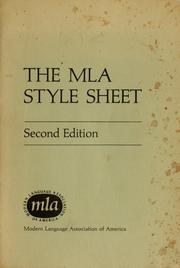
With the MLA Style Guide, 8th Edition, MLA Style is going back to its roots as a pamphlet, back when it was known as the MLA Style Sheet. I’m kidding, of course, but the 8th has slimmed down considerably.

But it apparently inspires strong passions, including Dallas Liddle’s “Why I hate the MLA Handbook” and Dallas Rossman Regaignon’s “Why I love the MLA Handbook.”Their reasons are basically the same: they hate/love its new flexibility.

The 8th edition has a philosophy of “containers,” which attempts to demystify the style for students and the rest of us. Herewith a few observations:
stylesheet

Figure 2. Where it all began, complete with spiffy Dewey Decimal number at the Open Library

1. Examples for in-text citation (which are very few) look just like the old MLA Handbook styles.

2. But if you look at the examples for documentation and Works Cited, your first thought may be, as mine was, “Cool! Commas, commas, commas for everything. This is like The Chicago Manual of Style 16! What an exciting meeting of the minds for the two competing styles to get together.”

3. URLs are back, but the detestable “Print.Print.Print” is gone.

4. There’s a whole list of “optional” elements, though, and the language used is user-friendly and sort of touching in its “you’re the Decider, so you decide” prose.

  • Book series title? You decide (p. 52).
  • Date of access for a web site? You decide (p. 53).
  • Place of publication (in the index under, for some reason, “cities of publication”)?  Since this “serves little purpose today” (51), yes, indeed–you decide.

5. What’s not optional: spell out “translated by, edited by” and so on in the Works Cited entry, same as in Chicago Manual of Style 16 14.78 and following, except that Chicago abbreviates them in notes. MLA does not.

6. And “pp.” is back, in the Works Cited.

7. But the most heinous and bedevilling of distinctions, as pointless as ever, is back: having to put in the issue number if a periodical is paginated by number and having to omit it if it is paginated by volume.

It’s right there on pp. 39-40.  If the journal is paginated by ISSUE, include the issue number. If it’s paginated by VOLUME, don’t.

How many hours have been wasted on trips to the library because you–okay, I–forgot to check this detail? Say you have an issue from January 1901. How do you know, except by looking at previous volumes, whether this is numbered by ISSUE or by VOLUME?

Answer: You don’t. You can’t. So if you didn’t write it down, back to the library you go to find out.  That’ll teach you–or, well, it taught me–to check this detail every single time.

mlaexample

Figure 3. The 7th edition and its sweet, agnostic system for volume.number.

The MLA mercifully axed this one in the 7th edition. In section 5.4.2, even their entries for paginated-by-year periodicals like Critical Inquiry use the issue number. Issue numbers for all!

I thought that the 7th edition had put a stake through the heart of this rule forever. But as if rising from the grave, the undead Volume.Number (only if paginated by issue, remember!) rule is back. In contrast,  Chicago 16 14.18 says that the number “may be omitted” but doesn’t prescribe it.

Summary: MLA has worked hard to simplify its rules, and ultimately we’ll all follow whatever they tell us anyway, as best we can. Our opinion is a moot point, or, as Joey said on Friends, “a moo point. You know, like a cow’s opinion: it doesn’t count.”

Anything that brings the two major style guides in English closer together is a step in the right direction.

Some serious sites that describe the differences:

MLA: https://www.mla.org/MLA-Style/What-s-New-in-the-Eighth-Edition

Purdue OWL: https://owl.english.purdue.edu/owl/resource/747/22/

https://www.easybib.com/guides/citation-guides/mla-8/mla-7-vs-mla-8/

A Modest Proposal for MLA 2016: Endorse Skype Interviews

Question: On what issue do ChronicleVitae/Slate blogger and frequent MLA critic Rebecca Schuman and MLA Executive Director Rosemary Feal agree?

Answer: Skype (or videoconference) videos instead of, or at the very least as a valid alternative to, the MLA conference interview.

Schuman reports that some potential candidates had their interview invitations withdrawn when they requested a Skype interview instead.  I can’t speak for all institutions, but that ought to be against the rules.

Should not having $1000 to spend on travel preclude a first-round interview? (And it’s really more like $1500 than $1000, which is a lot of money.) No, it shouldn’t. This is a first-round interview, with campus interviews still to come. The members of the department will still get to meet the second-round candidates as usual.

One angle not yet addressed in various articles about this is the perspective of the search committee.  Maybe some schools send the entire committee, but many more send 1-2 members to do the interviews, partially funding them, with possible assistance from whatever department members are available at MLA.

With a Skype interview, the entire search committee could arrange to be present to interview candidates, thereby giving more members exposure to the candidates and allowing for more input from the entire committee. Those not at MLA wouldn’t have to rely on the reports and notes of those who went, as now happens.

This is the sort of issue that the MLA should put its weight behind, at least to the point of having a discussion or resolution about it in the Delegate Assembly. It may not be as weighty or contentious as some of the issues debated over the past few years, but it will have a direct impact on the organization’s most financially vulnerable members.

Brief notes on MLA 2015

IMG_0747If I were Rosemary Feal, I’d declare MLA 2015 a victory: great venue, terrific papers, and a seemingly more relaxed set of conference attendees than the last two.

First, the amenities: MLA 2015 was held in a great place (Vancouver, BC), with easy access between the hotels and the convention center. The wifi was free and plentiful, and both the beautiful surroundings and the absence of slush made the physical experience of the conference really pleasant.

The papers were excellent, too, at least those I heard. Our session s#8 on Pacific Northwest Regionalism: Acts of Recovery, went very well, with lots of good discussion from the audience, and I would be remiss not to mention the great panel on “Edith Wharton and Sex” that provided new ways of looking at Wharton’s work on this topic.

Another outstanding panel was this morning’s “Antebellum Print Culture and the Digital Archive” (link is to the Storify collection of tweets) and the panel on Retrofuturism.

This was my last year on the Delegate Assembly, so while I will miss seeing the deliberative processes next year (if I go), I’ll be able to get to more panels.

American Naturalism at the MLA

If you’re heading to MLA this week, here are some panels about some American realist/naturalist authors. The “Animal Studies in Evolution” panel is at the same time I’m presenting, so I won’t be able to attend that one.

Stephen Crane, Ellen Glasgow, Ann Petry, W. D. Howells, Edith Summers Kelley, Kate Chopin — none

Theodore Dreiser — 337. The Genesis and Development of the Chicago Renaissance
Friday, 9 January, 3:30–4:45 p.m., 112, VCC West https://www.mla.org/program_details?prog_id=337&year=2015

Frank Norris and Jack London:
13. Animal Studies in the Age of Evolution Thursday, 8 January, 12:00 noon–1:15 p.m., 115, VCC West https://www.mla.org/program_details?prog_id=13&year=2015

Edith Wharton
185. Edith Wharton and Sex Friday, 9 January, 8:30–9:45 a.m., 207, VCC West https://www.mla.org/program_details?prog_id=185&year=2015

295. Narratives of Reproductive Rights in American Literature
Friday, 9 January, 12:00 noon–1:15 p.m., 223, VCC West
https://www.mla.org/program_details?prog_id=295&year=2015

Paul Laurence Dunbar: 
699. Black Optimism and Afro-Pessimism: The Politics of Pleasure and Pain in the African American Canon
Sunday, 11 January, 10:15–11:30 a.m., 222, VCC West
https://www.mla.org/program_details?prog_id=699&year=2015

John Dos Passos
339. Twentieth-Century American Literature and Sound Recording
Friday, 9 January, 3:30–4:45 p.m., 217, VCC West https://www.mla.org/program_details?prog_id=339&year=2015

306. Queer Capital: Transgressive Economies of Value in American Fiction
Friday, 9 January, 1:45–3:00 p.m., 216, VCC West https://www.mla.org/program_details?prog_id=306&year=2015

#mla2014 Session 601: Naturalism and Poverty: New Perspectives in Comparative Context

One of the sessions related to the Presidential Theme, Vulnerable Times

601. Naturalism and Poverty: New Perspectives in Comparative Context
Saturday, 11 January3:30–4:45 p.m., Mississippi, Sheraton Chicago

A special session
Presiding: Eleni Eva Coundouriotis, Univ. of Connecticut, Storrs

1. “No Money, No Money, No Money: Renaturalizing Jean Rhys,” Andrea P. Zemgulys, Univ. of Michigan, Ann Arbor

2. “Wasted Bodies: Poverty, Disability, and Cinematic Naturalism in Wharton, Crane, and Early Film,” Donna M. Campbell, Washington State Univ., Pullman

3. “The Adulterous Geopolitical Aesthetic: Naturalism and the Literary Channel before Zola,”Lauren M. E. Goodlad, Univ. of Illinois, Urbana