Most Edith Wharton scholars know the name Morton Fullerton (1865-1952): the handsome, elusive, charming, intelligent scoundrel who was Wharton’s lover for some time during 1907-09 (biographers Hermione Lee, Shari Benstock, R. W. B. Lewis, and other critics differ on their timelines). Their letters have been published, as has Wharton’s diary of the time (“L’âme close”), so that information is available elsewhere.
What’s puzzling me today is part of the backstory of Lewis’s biography of Wharton. Briefly put, Wharton’s papers at the Beinecke Library were embargoed for thirty years after her death, and Lewis, who had been chosen as her biographer, had exclusive or near-exclusive access to them during that time. (If this isn’t correct, please leave a note in the comments.) Lewis’s biography, Edith Wharton: A Life was published by Harper & Row in 1975 and deservedly won the Pulitzer Prize for biography.
But to complete the biography, Lewis, as is customary, hired researchers to search for documents. One of them, the Wharton scholar Marion Mainwaring, wrote to the Times Literary Supplement charging Lewis with errors in misrepresenting the information that she had shared with him. Playing on the title of Edmund Wilson’s 1955 anthology The Shock of Recognition: The Development of Literature in the United States Recorded by the Men Who Made It, Mainwaring called her article”The Shock of Non-Recognition: Errors in R. W. B. Lewis’s Biography of Edith Wharton (TLS 16 December 1988).
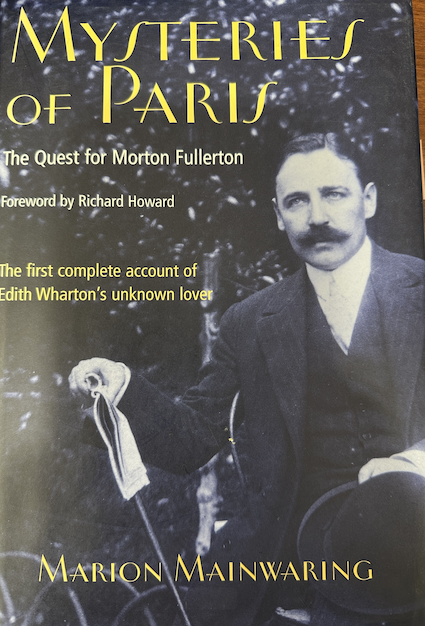
In 2001, Mainwaring published Mysteries of Paris: The Quest for Morton Fullerton, subtitled “The first complete account of Edith Wharton’s unknown lover.” The book is a great read, and it indeed draws the reader in like a mystery and at times a comedy, when Mainwaring tries to get documents or clues from a series of inscrutable French bureaucracies. Wharton was not, let us say, the only woman in Fullerton’s life: there was the Ranee of Sarawak (Lady Brooke), Camille (“Ixo”) Chabbert, Hélène Pouget, and Katherine Fullerton Gerould, the cousin who was brought up as his sister, to whom he was engaged during his affair with Wharton. Someone (I’ve forgotten who) was blackmailing him at the time, too. I’m not trying to mar Fullerton’s reputation, but this fact is relevant when we consider the picture.
The Picture
In the picture section, however, something seems off. Right across from the dapper portrait of Fullerton seen on the cover of the book is this one:
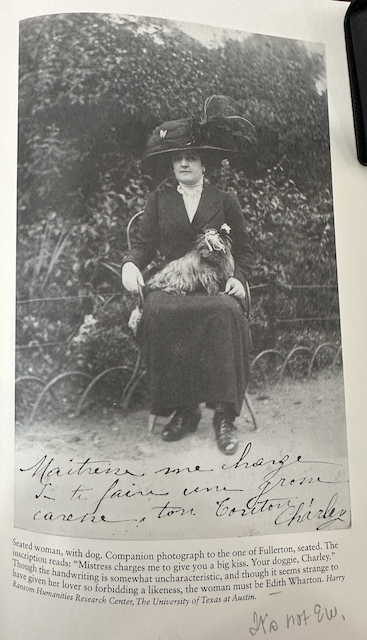
My immediate reaction, as you can see from the penciled annotation, is that this is definitely not Edith Wharton. What do you think?
This is also the picture used in Mainwaring’s “The Shock of Non-Recognition,” where it is credited to the article on Wharton in the Dictionary of Literary Biography, volume 9, written by Cynthia Griffin Wolff.
Mainwaring’s caption equivocates about it:
Seated woman with dog. Companion photograph to the one of Fullerton, seated. The inscription reads: “Mistress charges me to give you a big kiss. Your doggie, Charley.” Though the handwriting is somewhat uncharacteristic, and though it seems strange to have given her love so forbidding a likeness, the woman must be Edith Wharton. Harry Ransom Research Center, The University of Texas at Austin
You can see by the wording–“must be Edith Wharton–that Mainwaring realizes it might not be.
Why is it probably not Wharton? Here’s why I think so:
- This picture may be the companion to Fullerton’s portrait in the same place, but that is no reason to identify it as Wharton. Couldn’t it be one of the other women in his life with whom he had taken a set of pictures in the park? There are others whose circumstances might better fit this scenario.
- Appearance. In facial features, the woman does not look like Wharton at all. The nose, eyes, and chin all seem different, and the angle of the woman’s head is not one seen in other Wharton pictures.
- Clothing. I’m not a fashion historian, but the outfit seems less well put-together and well-tailored than the clothing in all the other portraits of Wharton, who was well-dressed and proud of it. (Recall that when her mother asked her what she wanted to be when she grew up, she said “The best-dressed woman in New York.”) Something about the cloth seems cheaper than her usual fabrics. Also: Wharton was proud of her feet and shoes (this was in a memoir). I’m trying not to be classist here, but these shapeless shoes don’t look like something that a very wealthy woman would wear.
- The message. Wharton had a lot of little dogs, but I don’t recall one called “Charley” or any name like it. They were usually called by French names or ersatz French names (“Mitou”).
- The handwriting. Mainwaring hedges–“somewhat uncharacteristic”–but in no universe does this look like Wharton’s handwriting. By now I’ve worked with her handwriting across hundreds of pages for the past fifteen years, and–nope, not it.
- I had asked a fellow Wharton scholar one time about this portrait, and he/she/they (anonymized) had instantly agreed: Not Wharton.
So what do you think? Wharton or not Wharton?
 Donna M. Campbell
It seems very unlikely that it is Edith Wharton. Quite apart from what seems like a complete lack of facial resemblance, the pair of photographs seem to have been taken in a public place [a park?] rather than a garden, and it is hard to imagine Wharton agreeing to such a thing. But I am ready to be proved wrong, when someone discovers copies of the two photographs in some yet undiscovered collection of Wharton’s private papers.