Volume Editors have many methods of comparing texts, some of which are text based (relying on typed text) and some of which are image based (relying on photographs or physical volumes). This is a very limited list. If you have other resources, please feel free to add them in the comments.
Volume Editors have many methods of comparing texts, some of which are text based (relying on typed text) and some of which are image based (relying on photographs or physical volumes). If you have other resources, please feel free to add them here.
Different methods, text-based or image-based, will work better depending on what you’re comparing.
- EDITIONS, which will usually be set from different plates and have different typefaces and page numbers (e.g., Scribner’s first edition, Macmillan [British] first edition, and so on), can’t be compared with image-based technology because of the the differences in typefaces and pagination. What’s on page 31 of the Scribner’s first edition of The House of Mirth will not be similar enough to what’s on page 31 of the Macmillan edition to make a comparison of individual words and letters possible, for the words will not be on the same lines. EDITIONS will need to be typed so that the text can be compared using Juxta or another text-based method.
The image on the left is from page 31 of the first Scribner’s edition of The House of Mirth; the second image is from page 31 of the Macmillan (British) first edition.


- PRINTINGS, which will be printed from the same plate as the first edition with the same typeface and page numbers, will differ little in appearance. The same material will be found on p. 3 of the Scribner’s edition, first printing and the Scribner’s edition, 5th printing, and the words will appear on the same line. PRINTINGS can be compared using image-based comparison methods like the Hinman or other image-based technologies.
Text-based comparisons
Text-based comparisons let you look at the differences between two typed documents. Most of us are already used to doing this in Word, but Juxta Commons is useful for more complex comparisons.
Juxta Commons. http://juxtacommons.org/ This easy-to-use and free software can compare two screens of text at once and can identify the differences by highlighting them. Juxta looks like this: 
To get typed text to compare, you might try these:
-
- Typing the volume into a text editor (like Notepad or Text Wrangler) or into Word.
- Using a typed version or the raw OCR (Optical Character Recognition) version found online that you proofread carefully against the copy-text volume (usually the first American edition).
- When raw OCR text comes out of the scanner, you’ll see that it is kind of a mess. There are odd characters, like ! instead of 1, m instead of rr, and even worse. You can see a little of this if you try to convert a .pdf document back into text using Google Docs. Whenever scanned text is used, it has to be carefully proofread.You may see references to “cleaning” the raw OCR text. “Cleaning” is just a term from data processing; it means to correct the data (in this case the text) according to the scanned material so that it makes sense.
- Adobe Acrobat Pro can turn .pdf files into text, but the text it creates must be carefully proofread.
- Google Docs is supposed to be able to turn .pdf files into text, but the text it creates must be carefully proofread.
- Scanning the copy-text volume with a specialty software such as ABBYY Finereader https://www.abbyy.com/en-us/finereader/ This text must also be carefully proofread but is supposed to have fewer errors than other scanning to OCR (Optical Character Recognition) kinds of programs.
Image-based comparisons
If you have taken pictures of several printings of the volume you’ll be editing, image-based or digital comparison software will be helpful.
- Traherne Digital Collator, a free comparison and collation software. The Traherne Digital Collator compares two page images so that you can see differences between, say, the first and second printing of a volume.
The download links can be found here: https://oxfordtraherne.org/traherne-digital-collator/ and http://www.robots.ox.ac.uk/~vgg/software/traherne/. These methods work for different printings or states of the same edition but not for different editions that have different fonts.
In the screenshots below, the top image compares the first edition of The House of Mirth, from a copy in the Lilly Library, with a copy of the first edition in the Beinecke Library. Note the broken character on the running title (HOUSE), which is illuminated by a red color instead of purple in the second image.


2. Pocket Hinman. The Pocket Hinman is a free experimental app developed for James Ascher and DeVan Ard. It’s a free iPhone and Android app, available through the App store and here: https://rossharding.me/#/pockethinman/
The Pocket Hinman allows you to compare visually a volume that you’re looking at with a previous picture of a volume. Differences will stand out by flickering slightly.
Mechanical Comparators and Collators
If you live near a research library or are visiting one, you can use these older devices to compare physical volumes of the text: the two major kinds are the Hinman Collator and the Lindstrand Comparator. Developed by Charlton Hinman from WWII bomb target technologies that compared two images and found slight differences by flickering images and used in creating comparative versions of the First Folio, the Hinman Collator can find small differences that indicate changes from one printing to the next.
Here’s an article that lists the locations of mechanical collators:
“Armadillos of Invention”: A Census of Mechanical Collators
Author(s): Steven Escar Smith Source: Studies in Bibliography, Vol. 55 (2002), pp. 133-170 Published by: Bibliographical Society of the University of Virginia
Stable URL: https://www.jstor.org/stable/40372237


 File this one under esoteric news you can use. Now that the MLA Handbook, 8th edition, pp. 39-40 has reverted to the old rule (
 The Charles Scribner Archives at the Princeton University Library are a rich source for anyone doing research on Edith Wharton. They’re a rich source for research on other authors, too, for that matter, but I was there for Wharton and the edition of The House of Mirth I’m preparing for the
  , which sports a grayish-green cover unlike the familiar red binding used for most of her books. Wharton supervised every aspect of the publishing process with great attention, and, when she finally moved to Appleton and they mimicked the familiar red Scribner’s binding for The Reef and Summer.
 The next day, I returned, found an open gate, and went to the grave. It’s the white stone in front of the graves of his father (right) and grandfather (left).
 WSU has activated a new space for my Amlit and course sites at


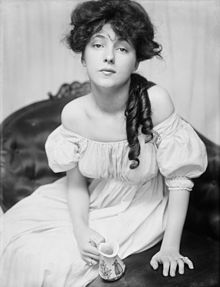 On the evening of June 25, 1906, the play Mam’zelle Champagne opened at the Roof Garden Theater atop what was still the new Madison Square Garden. On this particular evening, its architect, Stanford White, sat in the audience enjoying the musical comedy, seemingly unaware of the intense stares of a young man who, unusually for the warm evening, was wearing an overcoat. As the tenor swung into “I Could Love a Million Girls,” the young man left his seat and walked directly in front of White. “You have ruined my life!” the young man shouted, pulling a revolver from his coat and shooting White three times in the head and chest.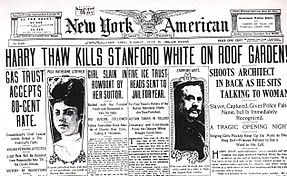
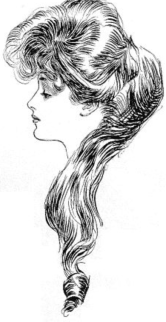 The young man was Harry K. Thaw, a millionaire from Pittsburgh, and the beautiful young woman with him was his unhappy wife, Evelyn Nesbit, who even before the murder was as famous in her own sphere as White was in his. Supporting her mother and brother through her work as a child model, Nesbit had moved to New York as a teenager and became a well-known artists’ model widely sought out for her soulful looks and masses of dark hair. Nesbit posed for such noted figures as Charles Dana Gibson, who used her as the model for his iconic “Gibson Girl” portrait “The Eternal Question,” and by her late teens, she had appeared in the Ziegfeld Follies before marrying millionaire Harry Thaw.
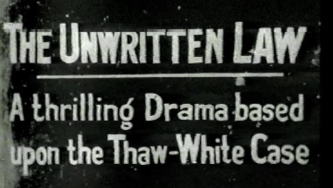 In a pattern that would become familiar in years to come, Nesbit’s story, first reproduced in the newspapers and later appearing in her two autobiographies, was reenacted by Nesbit herself in a series of a dozen movies beginning with
 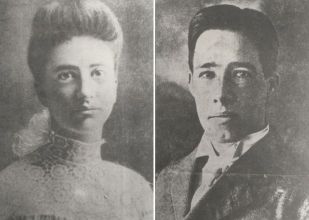 The Thaw case vied for attention with a later 1906 trial that dominated the New York press when Chester Gillette declared his innocence in the
 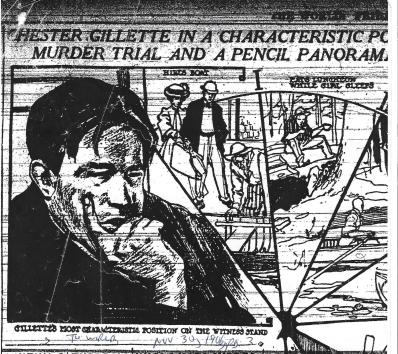 When Grace discovered that she was pregnant in the spring of 1906, Chester urged her to return to her family’s farm, promising to rescue her at a later date. By early July, when he had not done so, Grace threatened to return to Cortland and hold him accountable. Chester then took her on a trip to the nearby Adirondack Mountains from which she never returned.
 A few years later, Theodore Dreiser used the Gillette case as the basis for An American Tragedy (1925), and it had a second life as media fodder in its two film adaptations, Josef von Sternberg’s An American Tragedy (1931), a production that caused both Dreiser and Grace Brown’s family to sue Paramount Pictures; and George Stevens’s A Place in the Sun (1951), which starred Montgomery Clift, Elizabeth Taylor, and Shelley Winters in a contemporary adaptation of the story.
 Did Stephen Crane read Emily Dickinson? And was he inspired by her poetry?


 Donna M. Campbell