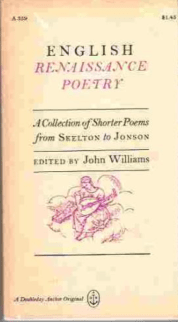
 In “John Williams and the Canon that Might Have Been” (at The New Yorker), Leo Robson writes about the novels of John Williams, who co-won (if that’s a word) the National Book Award in 1973 for his novel Augustus, along with John Barth’s Chimera. Williams is best known today for the academic novel Stoner (1965), which has undergone a huge resurgence since Williams’s death in 1994.
As Robson says, Williams represented something at odds with the expansiveness of a Saul Bellow, but what? Robson: “Williams had been spellbound by [Yvor] Winters’s authoritative tone and by a set of absolutist convictions relating not just to Anglophone poetry but to literature as a whole. Modish, persona-heavy metafiction or fealty to a more austere and straight-backed standard: this was not a difference that could be split.” [emphasis added]
Robson goes on to explain the theory underlying Williams’s practice:
Winters thought that the high point of literary expression had come and gone during the Renaissance, when “the tougher poets” like Fulke Greville wrote with a sense of rational order in the “plain style.” In the early eighteenth century, a decisive break had occurred—the start of what Winters branded Romanticism, defined as the misbegotten idea that “literature is mainly or even purely an emotional experience.” In the fullest statement of Winters’s views, “In Defense of Reason” (1947), a compendium of his earlier critical books, he railed against what he called “the fallacy of imitative form”—the tendency to express disintegration or uncertainty through language that itself exhibits those qualities. The “sound” alternative, Winters wrote, was to make a lucid statement “regarding the condition of uncertainty.” The “conscious author” and the pursuit of “formal perfection” emerged as desirable alternatives to “the fragmentary and unguided thought of the character, as he walks down the street, or sits in a bar, or dreams at night.”
Robson ultimately asks “What if cool analysis and formalist precision had gained greater purchase at the time?”
But there was one place where it did gain purchase, if only for a semester: a course on the short poem in English that I took as an undergraduate.
We worshiped the plain style.
Fulke Greville was it.
We were taught to have have little use for the Renaissance fancy guys like Sir Philip Sidney, because they were good but not plain. Literary quality was adherence to the plain style–tough, unemotional, understated.
Our principal text was John Williams’s English Renaissance Poetry. I didn’t know until Robson’s piece that this was (a) a transgressive and original anthology and (b) a book that seriously irritated Yvor Winters, who said “that Williams (‘the little bastard’) would make “a good deal of money out of me.”
 Our other main text was Yvor Winters’s Quest for Reality, a holy touchstone. (The cover I recall is a black and yellow one, but I may have conflated it with Forms of Discovery.) Wallace Stevens made the cut, too, as did J. V. Cunningham.
Shelley, Byron, Wordsworth, and the rest of the Romantics, on the other hand, were infra dig–definitely not plain, and far too emotional to be real poetry, which had to constrained and contained.
The shock of recognition (TM Edmund Wilson) that I had on reading Robson’s piece was that I hadn’t realized back then that I was being taught a school of literary criticism, much less one that had somehow gone underground and surfaced in an undergraduate class. I was being taught poetry, full stop, and accepted those standards as given.
In addition to being interesting in its own terms and in reintroducing readers to John Williams, then, Robson’s essay is a reminder of how seriously students (well, one naive student, anyway) take in what they’re told and the ways in which canonicity can shape young minds–even if it’s a minor or uncanonical canon.


 File this one under esoteric news you can use. Now that the MLA Handbook, 8th edition, pp. 39-40 has reverted to the old rule (
 The Charles Scribner Archives at the Princeton University Library are a rich source for anyone doing research on Edith Wharton. They’re a rich source for research on other authors, too, for that matter, but I was there for Wharton and the edition of The House of Mirth I’m preparing for the
  , which sports a grayish-green cover unlike the familiar red binding used for most of her books. Wharton supervised every aspect of the publishing process with great attention, and, when she finally moved to Appleton and they mimicked the familiar red Scribner’s binding for The Reef and Summer.
 The next day, I returned, found an open gate, and went to the grave. It’s the white stone in front of the graves of his father (right) and grandfather (left).
 WSU has activated a new space for my Amlit and course sites at


 On the evening of June 25, 1906, the play Mam’zelle Champagne opened at the Roof Garden Theater atop what was still the new Madison Square Garden. On this particular evening, its architect, Stanford White, sat in the audience enjoying the musical comedy, seemingly unaware of the intense stares of a young man who, unusually for the warm evening, was wearing an overcoat. As the tenor swung into “I Could Love a Million Girls,” the young man left his seat and walked directly in front of White. “You have ruined my life!” the young man shouted, pulling a revolver from his coat and shooting White three times in the head and chest.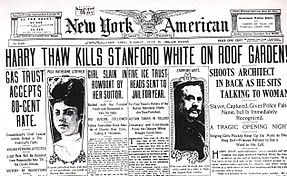
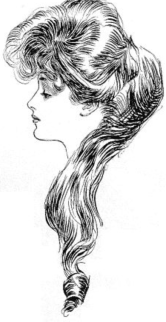 The young man was Harry K. Thaw, a millionaire from Pittsburgh, and the beautiful young woman with him was his unhappy wife, Evelyn Nesbit, who even before the murder was as famous in her own sphere as White was in his. Supporting her mother and brother through her work as a child model, Nesbit had moved to New York as a teenager and became a well-known artists’ model widely sought out for her soulful looks and masses of dark hair. Nesbit posed for such noted figures as Charles Dana Gibson, who used her as the model for his iconic “Gibson Girl” portrait “The Eternal Question,” and by her late teens, she had appeared in the Ziegfeld Follies before marrying millionaire Harry Thaw.
 In a pattern that would become familiar in years to come, Nesbit’s story, first reproduced in the newspapers and later appearing in her two autobiographies, was reenacted by Nesbit herself in a series of a dozen movies beginning with
 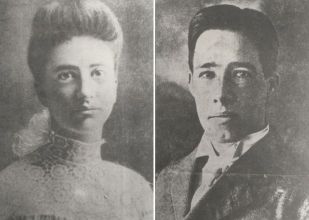 The Thaw case vied for attention with a later 1906 trial that dominated the New York press when Chester Gillette declared his innocence in the
 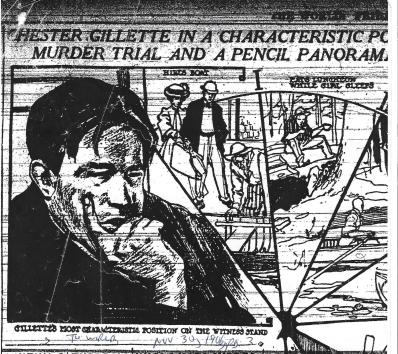 When Grace discovered that she was pregnant in the spring of 1906, Chester urged her to return to her family’s farm, promising to rescue her at a later date. By early July, when he had not done so, Grace threatened to return to Cortland and hold him accountable. Chester then took her on a trip to the nearby Adirondack Mountains from which she never returned.
 A few years later, Theodore Dreiser used the Gillette case as the basis for An American Tragedy (1925), and it had a second life as media fodder in its two film adaptations, Josef von Sternberg’s An American Tragedy (1931), a production that caused both Dreiser and Grace Brown’s family to sue Paramount Pictures; and George Stevens’s A Place in the Sun (1951), which starred Montgomery Clift, Elizabeth Taylor, and Shelley Winters in a contemporary adaptation of the story.
